The four conditions a spot has to supply
A powered cabinet manufactures its own storage conditions. A rack does not: it holds bottles in whatever conditions the room happens to have, which means choosing the location is choosing the storage. Four things decide whether a spot is good enough.
- Cool, and more importantly stable. Wine ages faster the warmer it is, but the bigger enemy is movement. A room that sits at 62°F all year does less damage than one that averages 58°F by running between 48 and 70. Every swing pushes wine in and out of the cork and works the seal.
- Dark. Ultraviolet light drives the reactions that produce lightstrike — the wet-wool, struck-match character that ruins a bottle. Clear and pale glass is the most exposed, because the bottle does none of the filtering. A rack offers no UV glass at all, so the room has to supply the dark.
- Still. Not a worry in most houses, but a rack bolted to the wall shared with a laundry, or standing on a floor above a workshop, is being shaken several times a day for years.
- Humid enough, not damp. Very dry air dries corks from the outside; very damp air destroys labels and cardboard. Somewhere in the middle, which most interior rooms are without anybody doing anything.
Notice that none of these is “cold.” A rack in a cool interior closet is doing a better job than a rack in a refrigerated room with a door that opens twenty times a day. If the room cannot supply these four, the honest answer is a cabinet rather than a rack — wine rack versus wine fridge is the head-to-head.
The rooms that actually work
A basement. The best wine storage most houses already own: below grade, insulated by the earth, dark, and stable across the year in a way no room upstairs is. If your basement holds the 50s or low 60s all year, a rack down there is genuinely cellar-grade storage. How to store wine in a basement covers the slab, the humidity and the damp, and basement racks ranks the hardware.
An interior closet. Underrated and available in almost every house. A coat closet or a linen closet on an interior wall has no exterior surfaces, no windows and no appliances, which is three of the four conditions for free. The only thing to check is that it does not back onto a hot-water cylinder or a heating riser.
Under the stairs. Same logic, usually with more usable volume and an awkward shape that suits modular racking better than furniture. Racks for small spaces covers that shape.
A north-facing pantry or utility room. Works if it is genuinely cool and the appliances in it are not heat sources. A pantry that shares a wall with an oven is not a pantry for this purpose. Pantry racks has the shelf-depth version of this question.
A hallway or a dining room, with conditions. These are the rooms people actually want the rack in, because a rack is partly furniture. They work if the spot is away from radiators, out of direct sun and not above a heat source. A display rack holding bottles you will drink within a few months is a perfectly legitimate use — the long-storage rules only bite over years.
Five places that look fine and are not
There is a sixth that is situational rather than absolute: the top of a kitchen cabinet run. It is out of the way and usually unused, and it is also where the warmest air in the room collects. For bottles that will be opened this month, fine. For anything being kept, no.
How to test a location before you trust it
Impressions about temperature are unreliable, and the mistake is expensive precisely because it is invisible — wine stored badly does not look any different until it is opened. The test is cheap.
- Leave a min/max thermometer in the exact spot, at the height the bottles will sit. Air temperature near the floor and near the ceiling of the same closet can differ by several degrees.
- Read it across a full year if you can, or at minimum across the hottest month and the coldest. The annual range is the number you are testing, not the average.
- Note what is on the other side of every wall. A closet that backs onto a boiler cupboard or a south-facing exterior wall will behave very differently from one surrounded by interior rooms.
If the swing is more than a few degrees or the summer peak climbs past the mid-60s, the room has failed and the answer is a cabinet. What happens to wine if it is not stored properly sets out what you are protecting against, and wine storage temperature covers the targets.
Wall, floor or shelf
Once the room is settled, the location within it decides the rack type, and the deciding factor is usually weight rather than taste.
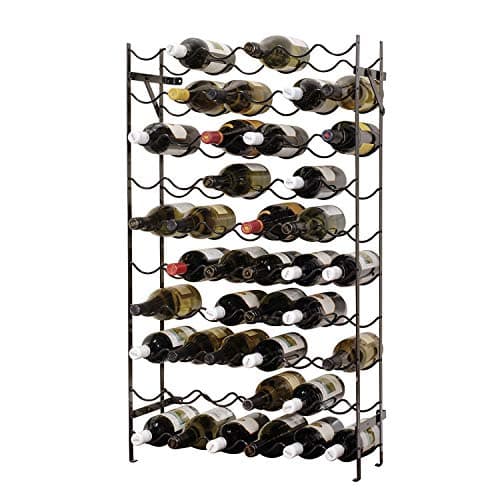
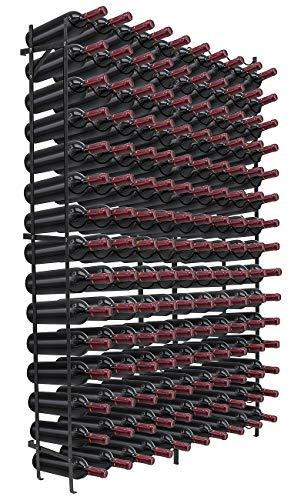
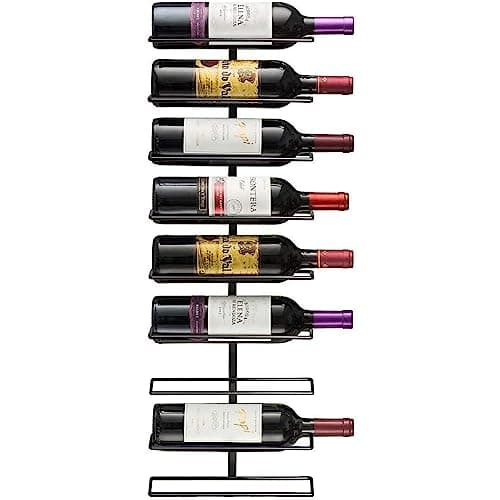
A full bottle of wine is roughly two and a half to three pounds. Nine bottles on a wall is around twenty-five pounds, which almost any fixing will hold. Sixty bottles is well over a hundred, which needs studs or proper anchors — and the Oenophilia Alexander, which holds sixty, publishes no load rating at all, which is exactly why its listing supports standing it on the floor as well as hanging it. A hundred and fifty bottles, as on the Sorbus floor rack, is roughly four hundred pounds and belongs on a slab.
Practical consequences:
- Wall racks suit small counts in rooms where floor space is the scarce thing, and they put bottles at eye level where the light is. Wall-mounted racks covers the fixings.
- Floor racks suit a basement or a closet, scale to real collections, and ask nothing of the wall. Floor racks is the roundup.
- Shelf and countertop racks are for bottles in use rather than bottles being kept, and they belong wherever you actually pour. Countertop racks covers them.