What freezing actually does to a bottle
Wine freezes a little below the freezing point of water, because alcohol depresses it; a typical table wine starts to freeze somewhere in the low to mid 20s Fahrenheit. A wine fridge is not supposed to be able to reach that at all, which is why this fault is a genuine malfunction rather than a settings preference.
Three things go wrong, in order of how early they appear:
- The cork lifts. Liquid expands as it freezes and the only way out is past the closure. A partly pushed-out cork is the classic visible sign, and once it has moved the seal is compromised even after the wine thaws.
- Tartrate crystals form. Harmless, and they look alarming — small glassy crystals on the cork or in the bottom of the bottle. They are a sign the wine got very cold rather than a fault in the wine itself.
- The bottle breaks. Less common and much worse, especially with sparkling wine, which is already under pressure.
A bottle that froze and thawed with the cork intact is usually still drinkable, if a little flattened. One whose cork lifted has been exposed to air and should be treated as opened. The broader picture of what bad storage does is in what happens to wine if it is not stored properly.
The five causes, in checking order
Work down this list. The first two cost nothing and explain most cases.
The second row catches more people than it should. On many cabinets the cold air enters from a specific point and a bottle pressed against it gets a concentrated blast while the rest of the cabinet sits at the set temperature. The display will be telling the truth and one bottle will still be slush. How to arrange bottles in a wine fridge covers loading patterns that keep air moving.
Ice on the back wall is a different symptom
Frost or a sheet of ice on the interior back wall is not the same complaint as frozen wine, although they often arrive together. It means moisture is condensing and then freezing on the coldest surface, which points at humidity getting in rather than at the thermostat.
The usual sources, in order of likelihood:
- A door that is not sealing. A perished or compressed gasket, a door left ajar by a bottle sticking out, or a cabinet that is not level so the door does not close square.
- A blocked drain hole. Most cabinets have a small drain channel at the back of the interior floor. Blocked, it holds water that then freezes.
- A very humid room, which pushes more moisture through every door opening.
Ice makes the fault worse on its own, because a layer of frost insulates the cooling surface and makes the cabinet run longer to compensate — which is how a small seal problem turns into frozen bottles. Wine fridge condensation covers the moisture side in full, and wine fridge maintenance covers defrosting and seal care.
The cold-room failure nobody expects
There is one scenario where a cabinet will chill bottles toward freezing and nothing is broken at all: the room is colder than the cabinet.
A wine fridge cools. It does not heat. If the cabinet is in an unheated garage, a porch or an uninsulated basement in winter and the room drops to 35°F, the interior simply follows the room down. The thermostat never asks for cooling because the interior is already below its setting, and the display will cheerfully report a number while the bottles freeze.
This is the main reason a wine fridge in a garage needs a cabinet rated for the ambient swing in both directions, and why garage-ready cabinets are a distinct category rather than marketing. A standard indoor cabinet in an unheated space is not protecting the wine from the winter — it is a box with a window.
When it really is the cabinet
If the setting is inside the published range, the bottles are clear of the vents, the room is a normal indoor temperature, the seal is sound and the interior is defrosted — and it still freezes — the thermostat or its sensor has failed. That is a service job, and on an inexpensive cabinet it is frequently not worth doing.
Two things make this diagnosable next time. First, keep an independent thermometer in the cabinet: a display that disagrees with a separate thermometer is the clearest evidence of a sensor fault you will get at home. Second, when replacing, prefer cabinets whose manufacturers publish a full temperature range — a model with no published range gives you nothing to measure the fault against.
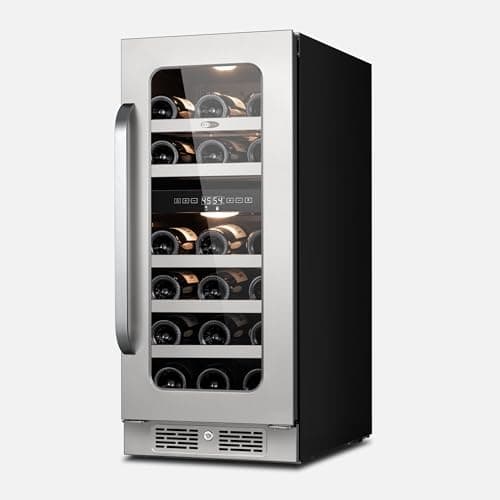
The Whynter BSR-029DW publishes 40–65°F across both zones and the Summit SWC1535B publishes 41–64°F, which is the kind of documentation that makes this fault arguable with a manufacturer rather than a matter of opinion. If the cabinet is still under warranty, raise it before you start taking panels off, and see how long wine fridges last for what is reasonable to expect from the unit you have.