
The short answer, and the catch
Yes, you can age wine in a wine fridge, and for most people it is the best storage available without building a room. A cabinet held at 55°F in the dark, with the bottles on their sides and the door left shut, reproduces the conditions a passive cellar provides by geology.
The catch is that “aging” is not a mode you switch on. It is the absence of events — no temperature swings, no light, no vibration, no being opened — sustained for as long as the wine needs. Which means an aging cabinet is defined by what it does not do, and almost none of that appears on a spec sheet as a feature.
It also means the cabinet you buy for aging is usually not the cabinet you want in a kitchen. The two jobs conflict: a kitchen cabinet is opened daily and run cold for service, and both of those are the opposite of aging. If you want to do both, the realistic answer is two zones run as storage-and-service, or two cabinets.
Stability beats coldness
This is the whole argument and it is worth being precise about. Wine ages through slow chemical reactions whose rate roughly doubles for every 18°F increase in temperature. So a cellar at 65°F ages wine faster than one at 55°F — but evenly, and evenly is survivable.
What is not survivable is the swing. Wine expands and contracts with temperature; the bottle does not. Repeated cycling pushes wine past the cork and pulls air back in behind it, which is why a seeping capsule and a cork pushed proud are the classic signatures of badly stored wine rather than of warm wine. The damage inventory is in what happens to wine if it is not stored properly.
That ranking — stability first, absolute temperature second — is what lets a cabinet beat a basement. A basement that runs 48°F in February and 74°F in August is worse storage than a cabinet sitting at 58°F every day of the year, even though its average looks fine. Target band and the reasoning are in wine storage temperature, and the head-to-head in wine fridge vs wine cellar.
Why an aging cabinet wants one zone
Counter-intuitively, the cabinet you want for aging is the simpler one.
Everything you are keeping wants the same temperature — about 55°F, red and white alike. A second zone adds a second thermostat, a second compartment to manage and, in practice, a reason to open the cabinet more often. Nothing in a dual-zone cabinet makes wine age better; it makes wine serve better.
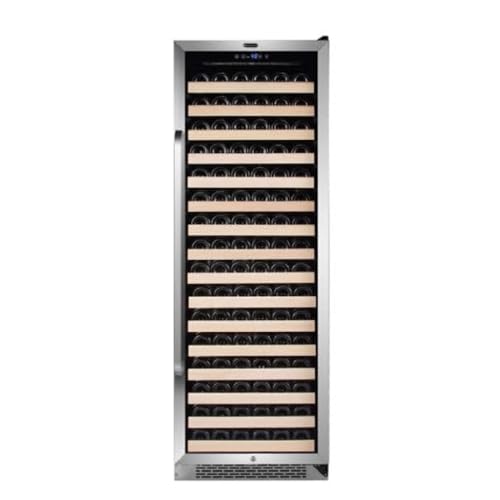
So the aging shortlist leans single-zone and large. The Whynter BWR-1662SD publishes 166 bottles in one zone with sixteen removable wooden slide-out shelves and a published range of the low forties to the mid sixties — 55°F sits comfortably in the middle of that, which is where you want your setpoint rather than at the edge of the range. The EuroCave Pure L publishes up to 110 reds as a multi-purpose storage cabinet with a five-year warranty.
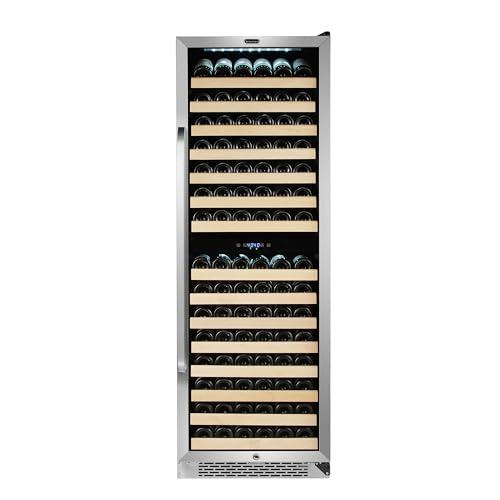
A dual-zone cabinet is not disqualified, and the Whynter BWR-1642DZ is on this page for a reason: both of its zones carry the full 40–65°F range, so you can simply set both to 55°F and run a 164-bottle cabinet as a single cellar. That is the useful trick — a dual-zone cabinet where both zones span the full range is strictly more flexible than a single-zone one. A cabinet whose zones are fixed to narrow bands leaves far less room: the Newair AWR-290DB runs 40–55°F up and 50–66°F down, so 55°F is the only cellar temperature both halves can hold, and it sits at the very top of the upper zone’s band. Full decision in single zone vs dual zone.
Vibration, and what is actually published
Vibration is the aging-specific worry that is genuinely hard to shop for, because almost nobody publishes anything about it.
The concern is real in principle: continuous low-level vibration keeps sediment in suspension and is widely believed to accelerate unwanted reactions over years. The concern is also the most over-sold thing in this category, because every manufacturer says “quiet compressor” and that is a noise claim rather than a vibration claim.
Two practical conclusions. If vibration is your priority and the collection is small, a thermoelectric cabinet has no compressor at all — but its 46°F floor and modest capacity make it an odd aging choice, and it still has a fan. If the collection is large, the realistic move is a compressor cabinet on a solid floor, loaded low, left alone; bottles at the bottom of a full cabinet sit in the stillest part of it. Layout detail in how to arrange bottles in a wine fridge, and the noise-versus-vibration distinction in wine fridge noise explained.
The cabinet has to last as long as the wine
Here is the failure mode nobody plans for: the wine is fine and the appliance dies. A cabinet bought to hold bottles for a decade is making a decade-long promise, and a compressor that fails in year six while you are away is a worse outcome than storing the same bottles in a cool closet.
Three things reduce that risk, and only one of them is a purchase decision.
- A published compressor warranty. The Zephyr PRW15C01CG publishes two years parts and labor with five years on the compressor; EuroCave publishes a five-year warranty on the Pure L. Most cabinets publish nothing, which is itself information.
- Maintenance. Condenser dust, a tired door seal and a blocked drain are what kill cabinets, and all three are preventable in twenty minutes twice a year. The routine is in wine fridge maintenance, and realistic service life in how long do wine fridges last.
- Knowing early. A cabinet drifting warm is silent. If the bottles matter, put a cheap min/max thermometer inside and glance at it when you walk past — it turns a six-month failure into a one-week one. First symptoms in wine fridge not cooling.
And: most wine does not age
Worth saying plainly, because it changes the size of cabinet you should buy. The large majority of wine sold is made to drink within about three years of release, and it does not get better in a cabinet — it gets older. Storing it well means it tastes the way the producer intended when you open it, which is a real benefit and a different one from aging.
The bottles that genuinely reward a decade are a narrow set: structured reds with real tannin and acid, a few whites with the acidity to carry them, sweet wines, and vintage sparkling. If that is five percent of your collection, you need a cabinet sized for the collection with a stable bottom shelf, not a 166-bottle cellar.
Sizing arithmetic in what size wine fridge do I need, the long-hold shortlist in best wine fridges for long-term storage, and if the cabinet is new, start with how to set up a new wine fridge.