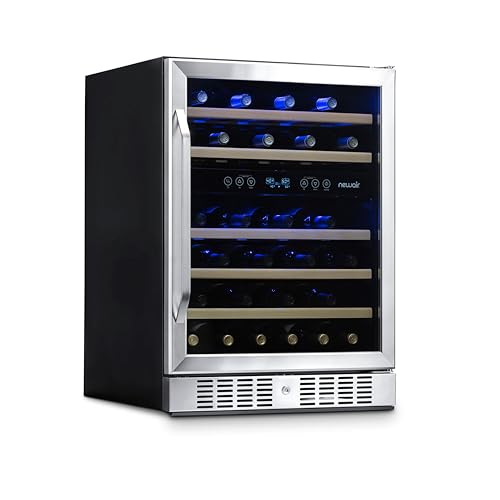
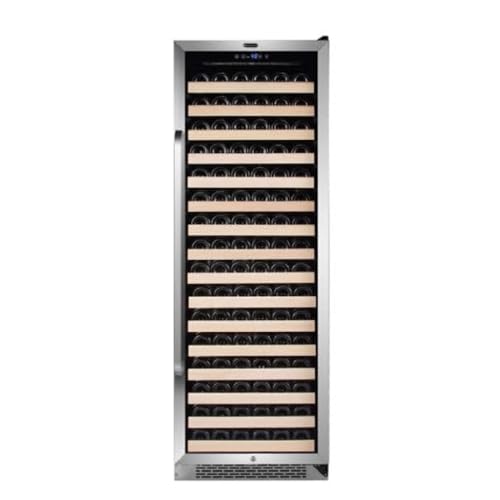
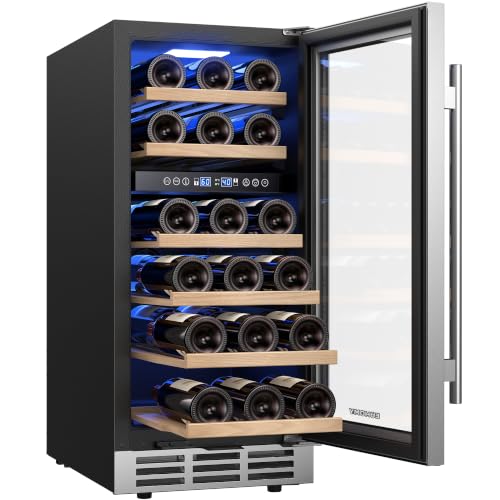
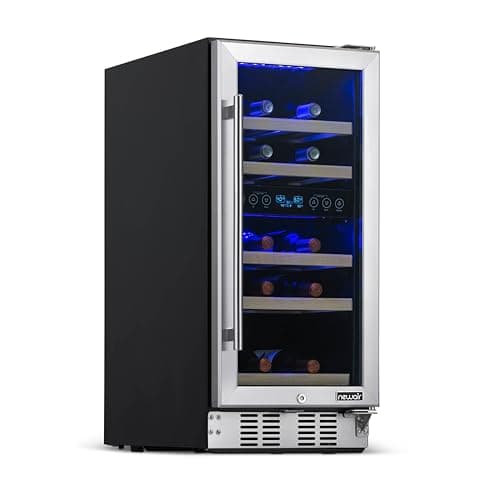
The Newair AWR-460DB is the best built-in wine fridge under $1,000: 46 bottles across two zones in a 23.4-inch body that drops into the standard 24-inch run, front-vented and rated for an enclosed opening. For capacity at one temperature, the 166-bottle Whynter BWR-1662SD. The budget pick is the EUHOMY BC-90CU-E, the cheapest built-in-rated cabinet here.
How this page is funded. Cork & Cool earns a commission if you buy through the Amazon links below, at no extra cost to you. It never changes the order of this list — see our editorial policy and affiliate disclosure. Prices come from Amazon and are refreshed daily; the price on Amazon when you buy is always the one that counts.
Quick picks
Every model below, on the specifications that decide the purchase. Tap a row to jump to the full write-up.
Comparison of wine storage models by zones, capacity, cooling type, width, published noise rating and vibration.
#
Product
Best for
Zones
Bottles
Cooling
Width
Noise
Vibration
Price
1
Newair AWR-460DBThe 24-inch slot
Forty-six bottles across two zones in a 23.4-inch cabinet rated for built-in or freestanding use
#ad — paid link. How this is funded. Price as of November 28, 2026; check Amazon for the current price.
“Not published” means the manufacturer does not publish that figure. We do not estimate it. Prices and product photographs come from Amazon and are refreshed daily.
How we compared
We compared published manufacturer specifications, official product documentation and verified owner reports across 5 models. We do not physically test these units, we have no laboratory, and we do not accept payment for placement. Where a manufacturer does not publish a figure — noise ratings, most often — this page says so rather than estimating it.
What we weighted
Rated by the manufacturer for installation in an enclosed opening — front-vented, not a freestanding cabinet pushed into a hole
A live price under $1,000 on the day we read it
Published exterior width against the 15-inch and 24-inch openings cabinetry actually provides
Published depth WITH the handle fitted, which is the number that decides whether the door clears a counter overhang
Published height, because an undercounter opening is usually 34 inches and two cabinets here are taller than they look
Capacity and zone count, so the fit decision and the storage decision stay separate
A published decibel figure where it exists — enclosing a cabinet makes noise louder, not quieter
Whether the cabinet may also stand free, which keeps the purchase useful if the kitchen plan changes
Every model in detail
Five cabinets, every one rated by its maker for a built-in opening and every one live-priced under $1,000 when this page was last reviewed. Four of the five may also stand in the open, which is the direction that is allowed; the reverse is not.
#1 — The 24-inch slot
Newair AWR-460DB
Forty-six bottles across two zones in a 23.4-inch cabinet rated for built-in or freestanding use — the default answer for a standard kitchen opening.
Product photograph via Amazon.
Published specifications
Capacity
46 bottles
Zones
2
Cooling
compressor
Temperature range
40–66°F
Noise rating
Not published by the manufacturer
Installation
both
· Exterior: 23.40 in W x 22.40 in D (24.00 in with handle) x 33.00 in H
Rated for built-in installation, so the front vent is designed for an enclosed opening
23.4-inch width drops into a standard 24-inch cabinet run
Two independently set zones across the full 40-66°F span
What does not
No published dB rating, so noise cannot be compared numerically against rivals
46 bottles is the manufacturer's count using standard Bordeaux bottles — heavy Burgundy or Champagne bottles reduce it
Who should skip it. Skip it if your opening is under 24 inches, or if you need more than about four dozen bottles — stepping up to a 160-bottle cabinet costs less per bottle.
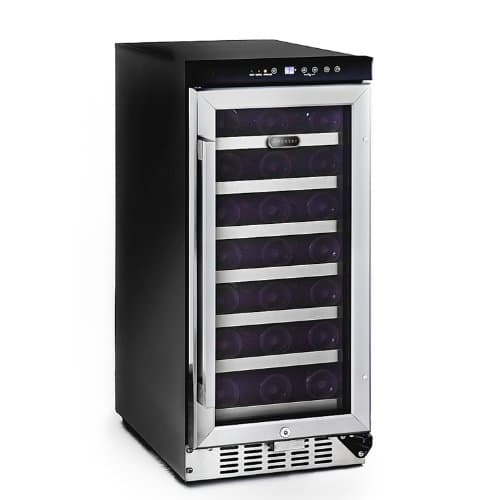
Thirty-three bottles in a 15-inch cabinet, with a published noise ceiling and seven wooden shelves — the capacity ceiling at this width, and the widest temperature band on this page.
Product photograph via Amazon.
Published specifications
Capacity
33 bottles
Zones
1
Cooling
compressor
Temperature range
40–72°F
Noise rating
42 dB
Installation
both
· Exterior: 15.0 in W x 22.5 in D (24.5 in with the handle installed) x 34.0 in H
· Capacity: 33 standard 750 ml bottles
· Noise published as "< 42 dBA" — a ceiling, not an average
Thirty-three bottles is the highest published capacity at this width
Whynter publishes a decibel ceiling, which almost nobody in this category does
Seven wooden shelves rather than the wire shelving usual at this price
40-72°F is the widest published band here, so it will also hold a bottle at room temperature
Rated for built-in or freestanding use, so an opening is optional rather than required
What does not
Single zone only — one temperature for the whole cabinet
The published figure is "< 42 dBA", a maximum rather than an average, so it cannot be compared like-for-like against a manufacturer quoting a flat number
At 15.0 inches published it is the widest cabinet in this group, which matters if your opening is tight
Depth grows to 24.5 inches once the handle is on, which is the figure that matters in a shallow run
33 bottles assumes standard Bordeaux shapes; a Burgundy-heavy collection will fit fewer
Who should skip it. Skip it if you need to serve whites cold and hold reds at cellar temperature in the same cabinet — one zone cannot do both. Skip it too if your opening measures under 15 inches, because this is the one cabinet here that needs the full module.
#ad — paid link. How this is funded. Price as of November 28, 2026; check Amazon for the current price.
#4 — Two zones in a 15-inch gap
EUHOMY BC-90CU-E
Thirty-three bottles across two independently controlled zones in a 15-inch opening, with a published noise ceiling, a reversible door and a lock — the service specification rather than the storage one.
Product photograph via Amazon.
Published specifications
Capacity
33 bottles
Zones
2
Cooling
compressor
Temperature range
40–65°F
Noise rating
38 dB
Installation
both
· Exterior: 14.9 in W x 23 in D x 34.25 in H
· Capacity: 33 standard 750 ml bottles; no per-zone bottle count published
· Upper zone 40-55°F, lower zone 55-65°F, each independently controlled
· Noise published as "< 38 dB" — a ceiling, not an average
· Shelving: six removable wooden shelves, specified to reduce vibration
· Door: double-pane UV-protective glass in a stainless steel frame, reversible
· Security: lock with two keys
· Front-vented, so it is rated for a built-in opening or freestanding use
A published decibel ceiling, which most cabinets at this width do not give you
Reversible door, so the hinge side is not decided for you
A lock with two keys, which matters more in a bar than in a cellar
The upper zone reaches 40°F, cold enough for sparkling service
Front-vented and rated both ways, so an opening is optional rather than required
What does not
The zones are split at the factory — 40-55°F above, 55-65°F below — so the cold half is always the top one
No per-zone bottle count published, so how the 33 divides is unknown until it arrives
The published figure is "< 38 dB", a maximum rather than an average
EUHOMY publishes no wattage, amperage or net weight for this model
23 inches deep, which is deeper than the 22.4-inch cabinets at the same width
Who should skip it. Skip it if you only ever hold one temperature: the single-zone Whynter BWR-33SD at the same width holds the same 33 bottles on seven wooden shelves across a wider 40-72°F span. And skip it if you need the cold half at the bottom, because this split is fixed.
Fits the 15-inch cabinet opening most kitchens already have
Zone split is set up for service temperatures rather than long-term cellaring
Triple-tempered glass is a real insulation step over the usual double pane
What does not
Neither zone covers the whole 40-66°F span: the upper stops at 55°F and the lower starts at 50°F, so the split is fixed rather than something you set
29 bottles fills fast if you buy by the case
Who should skip it. Skip it if you want one cabinet at a single cellar temperature — the fixed 40-55°F upper zone means half the unit is always a serving zone.
#ad — paid link. How this is funded. Price as of November 28, 2026; check Amazon for the current price.
What the built-in rating actually certifies
A built-in rating is a statement about airflow, not about looks. A freestanding cabinet dumps its waste heat out of the back or the sides and needs air around it; seal it into cabinetry and it breathes its own exhaust, runs continuously, fails to hold temperature and shortens its own life. A built-in-rated cabinet draws air in and pushes it out through the front plinth, so a sealed opening is the condition it was designed for.
Published fit specification, every built-in-rated cabinet under $1,000
Cabinet
Width
Depth with handle
Height
Bottles
Zones
Newair AWR-460DB
23.4 in
24.0 in
33.0 in
46
2
Whynter BWR-1662SD
24 in
Not published
Full-height column
166
1
Whynter BWR-33SD
15.0 in
24.5 in
34.0 in
33
1
EUHOMY BC-90CU-E
14.9 in
23 in
34.25 in
33
2
Newair AWR-290DB
14.8 in
24.25 in
33.75 in
29
2
The three numbers to measure before you choose
Width is the easy one and it is where most people stop. Openings come at roughly 15 and 24 inches because that is how base cabinets are built, and every cabinet here is cut to one of those two.
Depth with the handle fitted is the one that bites. The Whynter BWR-33SD is 22.5 inches deep as a body and 24.5 inches once the handle is on; the Newair AWR-290DB goes from 22.6 to 24.25 the same way. A standard base cabinet is 24 inches deep with a counter overhanging by an inch, so a cabinet that measures 24.5 inches stands proud of the run. That is a design decision you want to make deliberately rather than discover.
Height decides whether it is an undercounter cabinet at all. The EUHOMY is 34.25 inches tall, which is above the usual 34-inch undercounter opening; the Newair AWR-460DB at 33.0 inches has room to spare. Both are normal, but only one of them drops into a finished kitchen without a cabinetmaker. The full measuring sequence, including door swing and the plinth line, is in how to install a wine fridge under a counter.
The 15-inch opening: three ways to fill it
Three of these five cabinets fit a 15-inch gap and they answer three different questions. The Whynter BWR-33SD takes 33 bottles at one temperature across a published 40–72°F band — the widest span on this page, wide enough to hold a bottle at room temperature on purpose — and publishes a noise ceiling under 42 dBA, seven removable wooden shelves, a lock and an activated carbon filter. The EUHOMY BC-90CU-E takes the same 33 bottles but splits them into two controlled zones, publishes a lower ceiling of under 38 dB, and adds a reversible door and a lock with two keys. The Newair AWR-290DB takes 29 bottles in two zones behind triple-tempered glass.
Put plainly: one temperature and more bottles, or two temperatures and the same bottles, or fewer bottles and better glazing. There is no wrong answer, and the width class is ranked on its own terms in 15-inch wine coolers.
The 24-inch opening, and the column exception
At 24 inches the Newair AWR-460DB is the default: 46 bottles, two zones each covering the full 40–66°F span, removable beechwood shelving and a UV-protected double-tempered door, in a 23.4-inch body that is 24.0 inches deep with the handle. It is the cabinet most 24-inch kitchen openings should get, which is why it also tops 24-inch wine coolers.
The Whynter BWR-1662SD is the exception and belongs on this page for one reason: it is the only cabinet under $1,000 that holds 166 bottles. It is a full-height 24-inch column rated built-in only, single-zone across 40–65°F, with 16 removable wooden slide-out shelves plus a wire display shelf and a 140 W draw. It will not go under a counter and it is not a bar cabinet; it is a cellar that happens to be purchasable, and the trade-off against the dual-zone version of the same box is argued in the BWR-1642DZ against the BWR-1662SD.
What the ceiling costs you
Under $1,000 you give up four things. A panel-ready door, which lets the cabinet disappear behind your own cabinetry — those start around $1,500 and are ranked in best panel-ready wine fridges. Documented vibration control, which only a handful of makers publish at any price. A published humidity specification, covered in wine fridge humidity. And an NSF-listed commercial rating, which matters only if the cabinet is going into a business — see best commercial wine fridges.
You also give up published decibel figures on the two Newairs and on the Whynter column. Three of these five publish nothing, and in an enclosed opening that is a real unknown, because cabinetry reflects compressor noise forward into the room rather than absorbing it.
Which one to buy
For a standard 24-inch opening, the Newair AWR-460DB. For a 15-inch gap and the most bottles, the Whynter BWR-33SD. For a 15-inch gap and two temperatures, the EUHOMY BC-90CU-E, which is also the cheapest cabinet on this page. For a wall rather than a counter, the Whynter BWR-1662SD. And if your opening is panel-ready or taller than a counter, spend the extra: the undercounter cabinets under $2,000 publish the panel dimensions and the decibel figures this bracket does not.
Questions people actually ask
▸ Can I use a built-in-rated cabinet as a freestanding one?
Yes. Front-venting works fine in open air, so the rating only ever restricts you in one direction. Four of the five cabinets here are explicitly rated both ways; the Whynter BWR-1662SD is published as built-in only.
▸ Do I need a dedicated circuit for one of these?
Usually not for a 15-inch cabinet, but it depends on what else is on the circuit and on your local code. The published draws here run from 80 W to 140 W, and the reasoning is set out in does a wine fridge need a dedicated circuit.