What a thousand dollars actually buys
A thousand dollars is the most interesting ceiling in this category, because it is the point at which three things stop being compromises.
You get a compressor. Below about three hundred dollars the market is almost entirely thermoelectric, which means a cabinet whose cooling ability is tied to the temperature of the room around it — the honest version of that trade is in best cheap wine fridges and the mechanism itself in compressor against thermoelectric. Every cabinet on this page except the entry pick is compressor-cooled, and every one of them holds its setting on a hot August afternoon.
You get a built-in rating. Four of these five are published as built-in OR freestanding, which means the condenser vents forward and the cabinet can be enclosed in a cabinet run. That rating is the single most expensive specification to get wrong, because a freestanding cabinet pushed into a tight opening recirculates its own waste heat and dies out of warranty — built-in against freestanding is the whole argument, and ventilation and clearance is what each type actually needs.
You get real shelving. Wooden shelves that slide and come out, rather than the fixed wire racks that define the bottom of the market. It sounds cosmetic. It is not: a shelf you can remove is how a Champagne or Burgundy bottle gets into the cabinet at all, which is the point the large-format roundup makes at length.
What a thousand dollars does not buy is a column, a 160-bottle cabinet or a panel-ready door. Those start in the next bracket up, which is best wine fridges under $2,000.
Two checks that come before capacity
Almost everyone shops this bracket by bottle count, and almost everyone should shop it by two other numbers first.
The opening, including the handle. Kitchen cabinetry comes in modules: most runs have a 15-inch gap or a 24-inch gap, and nothing in between. Three of these cabinets are published between 14.8 and 15.0 inches wide and one is 23.4 inches — and the number that catches people is not width but depth with the handle fitted. The Newair AWR-290DB is published at 22.60 inches deep and 24.25 with its handle; the Whynter BWR-33SD at 22.5 and 24.5. In a shallow run with plumbing behind it, those extra two inches are the whole project. The dimensions guide sets out the measurements to take before you order.
The temperature span, per zone. A single figure on a box ("40–66°F") can describe two completely different cabinets, which is the next section.
Two zones, and the ones that only pretend
Three of these cabinets publish two zones, and they are not equivalent. This is the specification that separates them more sharply than price does.
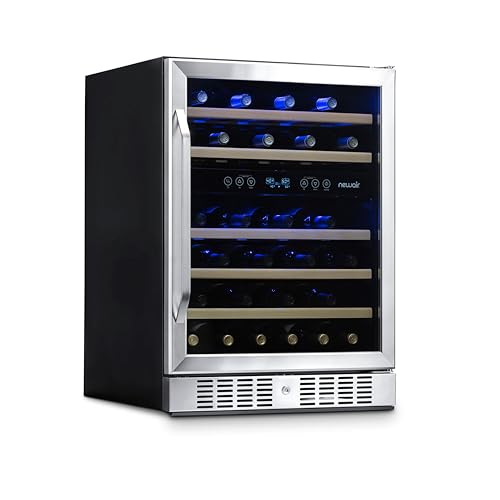
Both zones across the full span. The Newair AWR-460DB publishes 40–66°F for each zone. That means the split is yours: cellar below and service above, two cellars at one temperature for redundancy, or reds and whites both at drinking temperature. Nothing is decided for you — but it needs a 24-inch opening.
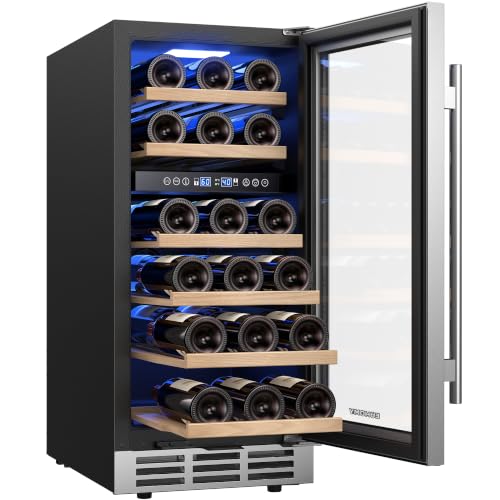
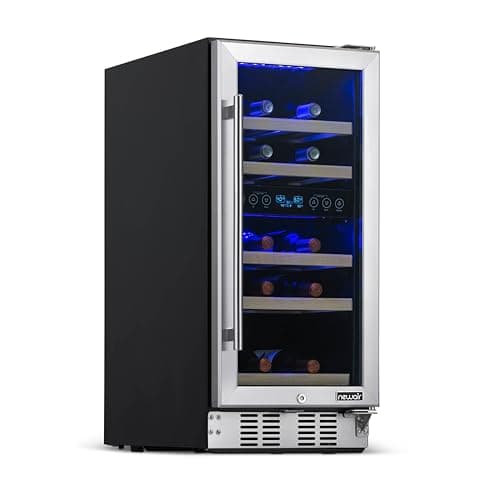
A split the factory already made. Both 15-inch dual-zone cabinets here work this way. The Newair AWR-290DB publishes an upper zone of 40–55°F and a lower of 50–66°F; the EUHOMY BC-90CU-E publishes 40–55°F above and 55–65°F below. On neither does a compartment cover the whole range, so both are permanently configured as service-above, cellar-below. That is a perfectly good cabinet if that is what you want — it is set up the way most households actually use a fridge — but it cannot be re-tasked later, and at this width nothing in our registry can.
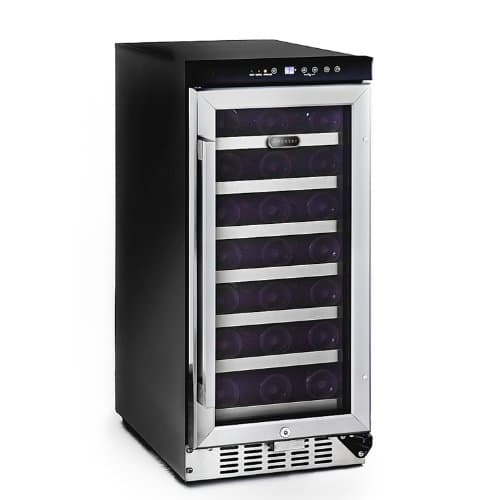
The catch is what each publishes about the split itself. The Newair states 29 bottles; EUHOMY states 33 but publishes no per-zone count, so how the 33 divides is unknown until it arrives. If you only ever hold one temperature, the single-zone BWR-33SD at the same width gives you the same 33 bottles on seven removable wooden shelves across a wider 40–72°F span. The full version of this argument is in single zone against dual zone, and which number to set each compartment to is in dual-zone temperature settings.
The noise figure almost nobody publishes
Two of these five publish a decibel figure. Three do not, and we will not invent one for them.
EUHOMY publishes under 38 dB for the BC-90CU-E and Whynter under 42 dBA for the BWR-33SD. Read the word “under” carefully: both are ceilings rather than averages, so they cannot be compared like-for-like against a manufacturer quoting a flat number, and they are not directly comparable to each other either. What they do prove is that Whynter was willing to put a figure in print, which in this category is itself a signal — the reasoning is in the noise guide, and the cabinets that publish the lowest numbers are ranked in best quiet wine fridges.
The practical point for this bracket: every compressor cabinet here cycles, and what people notice is the change rather than the level. If the cabinet is going in a bedroom, a home office or a studio apartment, that cycling matters more than any published figure, and the honest answer may be a thermoelectric cabinet from the cheaper bracket instead — no compressor, no cycling, and the limits set out in the thermoelectric roundup.
Bottles per dollar, honestly
We will not type a price into this page — prices here move weekly and a stale number is worse than no number — but the arithmetic is worth doing on the live figures shown on the cards above, because it points one way.
The 46-bottle cabinet is the best value in this bracket by a wide margin. It holds roughly 60% more than the 29-bottle cabinets for a step up that is nowhere near 60% more money at current prices. If you have a 24-inch opening, the arithmetic is not close.
Cost per bottle keeps falling above this bracket. A 160-bottle cabinet in the next bracket up costs less per bottle again, which is the uncomfortable truth about buying small: the cheapest way to store a lot of wine is to buy one big cabinet once. Before you decide, work out how many bottles you will actually keep — what size wine fridge you need does that from the bottles you own, and how many bottles a wine fridge really holds explains why every published count is optimistic.
And cost per bottle is not the only axis. A half-empty cabinet costs the same to run as a full one, the 24-inch cabinet needs a 24-inch opening you may not have, and a 46-bottle cabinet weighs over a hundred pounds before you load it. Bottles per dollar is the tiebreaker, not the decision.
Where the money stops
Four things are missing from every cabinet on this page, and knowing that up front is worth more than another paragraph of praise.
- No panel-ready door. Nothing in this bracket accepts a custom cabinet front; the glass door is the door. Panel-ready starts above it, and which makers publish the panel dimensions a cabinetmaker needs is in best panel-ready wine fridges.
- No documented vibration control. None of these makers publishes a vibration measure, so we do not claim one. The cabinets whose makers do publish something substantive are in the vibration and light roundup, and they cost more.
- No humidity control. Two of these cabinets ship an activated carbon filter, which is about air rather than moisture. What a cabinet can and cannot do about humidity is in do wine fridges control humidity.
- No capacity above about four dozen bottles. If your collection is already past 50 bottles, this bracket will be too small by the time it arrives.
When to spend less, and when to spend more
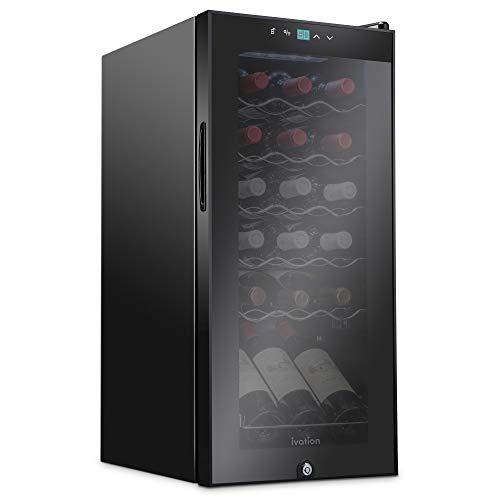
Spend less if the cabinet is for a dozen bottles you will drink this year, if it is going in a quiet room where a compressor would annoy you, or if it is standing on a counter rather than going into cabinetry. Half this ceiling still buys a compressor cabinet with a built-in rating — three of the five picks above sit inside it, which is the whole point of best wine fridges under $500 — and below that the thermoelectric case is made properly in best cheap wine fridges and best small wine fridges. The entry pick here — the Ivation 18-bottle compressor — is the bridge between the two: a compressor, a 41°F floor and a lock, in a cabinet that sits on the floor rather than in a wall.
Spend more if you want a 24-inch cabinet at 160-plus bottles, a panel-ready door, a published Energy Star listing or an ADA-height shallow-depth cabinet. All of those exist in best wine fridges under $2,000, and the per-bottle cost there is lower than anything on this page.
Spend nothing on a cabinet at all if you have a cool, dark, stable room. An unpowered rack in the right place beats a cheap cabinet in the wrong one, which is the case put in wine rack against wine fridge and at the budget end in best wine racks under $50.
Which one to buy
Buy the Newair AWR-460DB if you have a 24-inch opening. Forty-six bottles, two zones that each cover 40–66°F, 23.4 inches wide and 24.00 with the handle, 5.3 cubic feet, beechwood shelving and a built-in rating. It is the best bottles-per-dollar cabinet in the bracket and the only one here that fills a 24-inch module. The honest caveats: no published decibel figure, and 46 bottles is Newair’s count with standard Bordeaux bottles.
Buy the EUHOMY BC-90CU-E if you have a 15-inch gap and want two zones. It publishes a sub-38 dB ceiling, a lock with two keys, and a reversible door so the hinge side is not decided for you — see reversible doors and door swing — across 33 bottles. The costs are that the split is fixed at 40–55°F above and 55–65°F below, that EUHOMY publishes no per-zone bottle count, and that at 23 inches it is slightly deeper than the Whynter at the same width.
Buy the Whynter BWR-33SD if one temperature is all you need. Thirty-three bottles at 15 inches, the highest published capacity at that width, seven removable wooden shelves, a published sub-42 dBA ceiling, a lock, a carbon filter and the widest published band in this group at 40–72°F. It needs the full 15-inch module, and it is one zone only.
Buy the Newair AWR-290DB if the factory split suits you. Service above at 40–55°F, cellar below at 50–66°F, triple-tempered UV glass and a 15-inch body. It is the right cabinet for a household that chills whites and holds reds and will never want it configured any other way.
Buy the Ivation 18-bottle compressor as the entry. The cheapest cabinet here by a clear margin, and the only one under three figures of bottle count that still gets you compressor cooling, a 41°F floor cold enough for sparkling service, and a lock. It is freestanding only, so it cannot be enclosed, and at this size the compressor is close to you.
Whichever you buy, two things are worth doing on day one: set it up properly rather than plugging it in and filling it — how to set up a new wine fridge — and put a logging thermometer on the middle shelf, because the display reports what the control board is aiming at rather than what the bottles are in. Best wine fridge thermometers and hygrometers ranks those on published accuracy, and they cost a rounding error against the cabinet.
Two narrower cuts of this same bracket are worth reading if you already know what you need: best dual-zone wine fridges under $1,000 and best built-in wine fridges under $1,000.