1. Let it stand upright first
If the cabinet is a compressor model and it travelled on its side or at an angle — which most delivered appliances do at some point — stand it upright and leave it for at least 24 hours before switching it on. Twelve is the usual minimum in a manual; twenty-four costs you nothing and removes the risk entirely.
The reason is oil. A sealed refrigeration circuit carries compressor lubricant that is meant to stay in the compressor. Tilt the cabinet and some of it migrates into the refrigerant lines. Start the compressor before it has drained back and you run it under-lubricated and push oil through the capillary, which is a quiet way to shorten the life of the one part you cannot replace.
Thermoelectric cabinets — the Whynter WC-201TD, the Koolatron units, the Schmécké, the Ivation dual-zone — have no refrigerant circuit and no compressor oil, so this step does not apply. If you are not sure which you have, compressor vs thermoelectric tells them apart in a sentence.
2. Place it, level it, give it air
Three things in this order, and the second one is the one people skip.
Place it away from heat and sun. A cabinet next to an oven, a dishwasher or a south-facing window is fighting its environment every day, and a thermoelectric cabinet in that position cannot win at all — its cooling is relative to the room.
Level it. Every cabinet here has adjustable feet; the Summit ASDW2412 publishes adjustable legs and a sliding kickplate cover that take it from a 32-inch ADA height to 34 inches. Levelling does three jobs: it stops the door swinging open or failing to seal, it keeps condensate flowing toward the drain rather than pooling on a shelf, and it stops the cabinet transmitting compressor vibration into the floor as a buzz. Use a spirit level front-to-back and side-to-side, loaded if you can.
Give it air, according to its own manual and its own rating. This is the one that voids the whole exercise if you get it wrong: a freestanding cabinet vents out of the back or sides and must not be boxed in, while a built-in-rated cabinet vents forward through its grille and can sit flush. Installing a freestanding cabinet into cabinetry is the most common expensive mistake in this category — the clearances are in wine fridge ventilation and clearance and the install sequence in how to install a wine fridge under a counter.
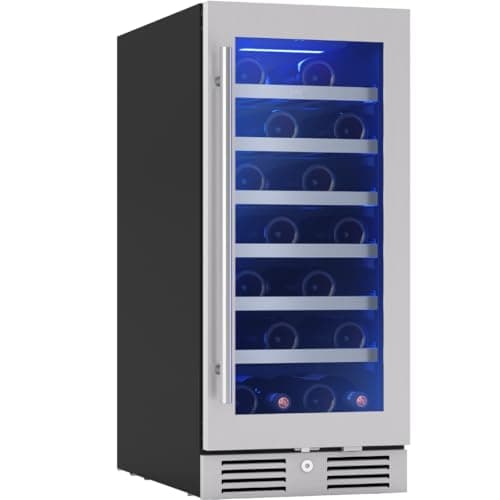
While the cabinet is empty is also the moment to reverse the door if you need to. Whynter publishes a reversible door on the BSR-029DW, Summit on the SWC1535B and SDHW1532 (right-hand swing as standard), Zephyr publishes field-reversible on the PRW15C01CG, and Kalamera a reversible stainless-framed glass door on the KRC-46DZB. It is a thirty-minute job on an empty cabinet and a bad afternoon on a full one. Reversible doors: which way should a wine fridge open covers how to decide the side before you touch a hinge, the sequence the reversal follows, and the doors that cannot be reversed at all.
3. Power, and nothing between it and the outlet
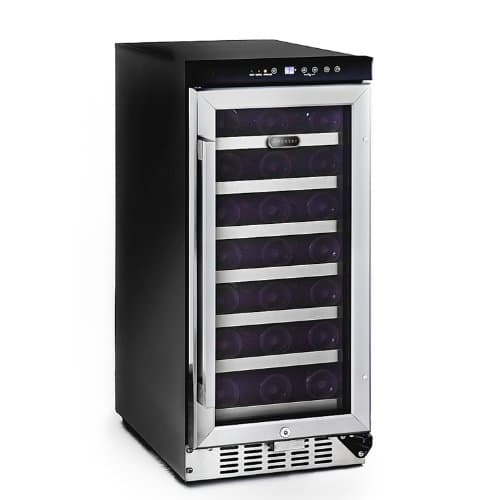
Every cabinet on this site runs on a standard grounded 115 V, 60 Hz household supply, and the published draws are modest: 80 W / 0.9 A on the Whynter BWR-33SD, 103.5 W / 0.9 A on the BSR-029DW, 160 W on the 164-bottle BWR-1642DZ, 65 W on the Whynter WC-201TD and the Ivation dual-zone, and a maximum of 1.5 A on the Zephyr PRW15C01CG.
Whether the cabinet needs a circuit of its own is a separate question with a mostly reassuring answer — see does a wine fridge need a dedicated circuit. What it definitely needs is an outlet that is not shared with a kettle or a microwave, because a compressor restarting into a loaded circuit is how nuisance trips happen.
4. Run it empty overnight
Switch the cabinet on empty, set it to the temperature you actually intend to use, and leave it overnight. Do not put wine in it on day one.
This step exists to find a failure before it costs you anything. An empty cabinet has very little thermal mass, so it reaches setpoint faster than a full one and any inability to get there is obvious within a few hours rather than a week. If it will not reach temperature empty, it is a warranty conversation, not a loading problem — and you have not yet put forty bottles inside something you need to send back.
Set the thermostat mid-range rather than at the edge of the cabinet’s published span, so it has room to work in both directions. About 55°F for storage; 45–50°F for a service zone. Targets by style are in wine fridge temperature settings and, for two zones, dual-zone temperature settings.
Put a cheap independent thermometer on a middle shelf during this run. A digital display on the door reports what the controller believes, which is not always what the middle of the cabinet is doing, and knowing the offset on day one is worth more than it sounds later.
5. Load it in one go
Loading a cabinet one bottle at a time over an evening means opening the door twenty times while the cabinet is trying to stabilize. Stage the bottles on a counter, decide the layout first, then load in a single pass.
The layout rules, in brief: bottles on their sides with labels facing out and necks the same way; heavy and large — Champagne, magnums — on the bottom shelf; the bottles you will open soonest at eye level; a finger’s gap at the back wall so air can reach the evaporator; and about 70 to 80 percent full rather than packed to the rating, so the cabinet can be rearranged. The long version is in how to arrange bottles in a wine fridge, and shelf-pitch considerations in wine fridge shelf types.
If any bottle in the collection is a Burgundy, Rhône or Champagne shape, work out now which shelf is coming out to make a double-height bay, rather than discovering it with a case on the counter. Summit publishes shelf removal for the SWC1535B for exactly this; most wooden-shelf cabinets here publish removable shelves.
What is normal in week one
A new cabinet does several alarming-sounding things that are not faults.
Two of those have their own pages: condensation in wine fridge condensation and sounds in wine fridge noise explained. If the cabinet is genuinely not getting cold, start at wine fridge not cooling.
Then put two things in the calendar and forget about the cabinet: a condenser clean and a door-seal check, twice a year. That routine is the whole of wine fridge maintenance, and it is the difference between the service lives described in how long do wine fridges last.