Every capacity figure in this category is counted in Bordeaux bottles. A cellar of Burgundy and Pinot is wider at the shoulder — and that is a shelving problem, not a cooling one.
The Summit ALWC532PNR is the best wine fridge for Burgundy bottles: it is the only cabinet on this site whose maker publishes a per-shape count — 46 bottles as 30 Bordeaux plus 16 wider Burgundy — on six full-extension shelves. For capacity at one temperature with uniform shelf spacing, the Whynter BWR-1662SD. The budget pick is the Koolatron WC12MG, whose wire racks lift out and adjust for irregular bottles.
This page sits in Wine Fridges, where the rest of the category is compared the same way.
How this page is funded. Cork & Cool earns a commission if you buy through the Amazon links below, at no extra cost to you. It never changes the order of this list — see our editorial policy and affiliate disclosure. Prices come from Amazon and are refreshed daily; the price on Amazon when you buy is always the one that counts.
Quick picks
Every model below, on the specifications that decide the purchase. Tap a row to jump to the full write-up.
Comparison of wine storage models by zones, capacity, cooling type, width, published noise rating and vibration.
#
Product
Best for
Zones
Bottles
Cooling
Width
Noise
Vibration
Price
1
Summit ALWC532PNRTwo zones behind a published panel
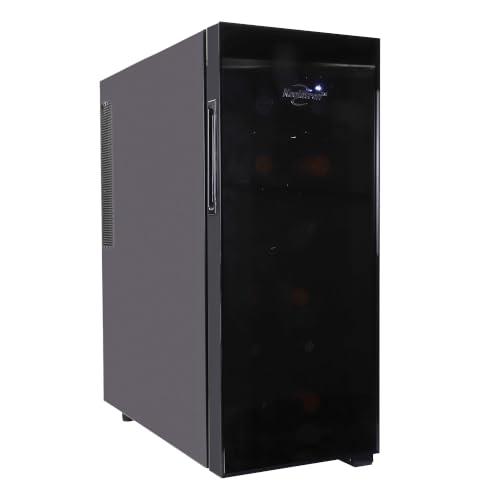
Forty-six bottles across two zones in a 24-inch panel-ready cabinet, with the recommended panel printed to the eighth of an inch and the viewable aperture published alongside it
#ad — paid link. How this is funded. Price as of November 28, 2026; check Amazon for the current price.
“Not published” means the manufacturer does not publish that figure. We do not estimate it. Prices and product photographs come from Amazon and are refreshed daily.
How we compared
We compared published manufacturer specifications, official product documentation and verified owner reports across 5 models. We do not physically test these units, we have no laboratory, and we do not accept payment for placement. Where a manufacturer does not publish a figure — noise ratings, most often — this page says so rather than estimating it.
What we weighted
Whether the maker publishes a per-bottle-shape capacity rather than a single Bordeaux-only figure — exactly one cabinet on this site does
Whether the shelves come OUT, because a fixed shelf is the single reason a wider bottle will not go in
Shelf spacing, and whether a single-zone cabinet gives uniform spacing top to bottom rather than a fixed split around a divider
Full-extension racking, because a wide bottle at the back of a shelf cannot be reached past the ones in front
Published interior depth or cabinet depth, since a Burgundy bottle is both wider and often shorter than a Bordeaux one
Shelving material, as wood cradles a wide base where chrome wire lets it roll
The honest consequence: a Burgundy-heavy collection stores fewer bottles than the box says, and by roughly how much
Every model in detail
Five cabinets ranked on what they do with a wide bottle. Where a maker publishes a shape-specific count or a shelf specification we quote it; where it does not, we say so rather than estimating from a photograph.
#1 — Two zones behind a published panel
Summit ALWC532PNR
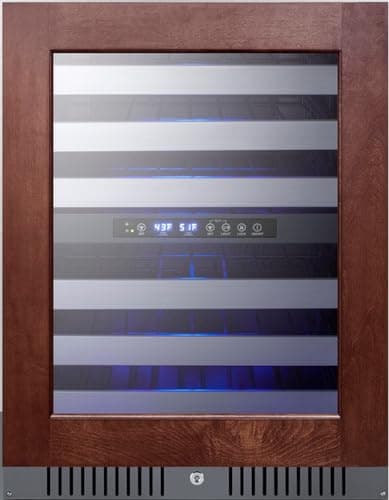
Forty-six bottles across two zones in a 24-inch panel-ready cabinet, with the recommended panel printed to the eighth of an inch and the viewable aperture published alongside it — which is what a cabinetmaker actually needs before quoting the door.
Product photograph via Amazon.
Published specifications
Capacity
46 bottles
Zones
2
Cooling
compressor
Temperature range
41–64°F
Noise rating
34 dB
Installation
built-in
· Exterior: 23.38 in W x 23.5 in D (24.25 in with the panel fitted) x 32.0 in H
· Depth with the door open at 90 degrees: 47.38 in
· Capacity: 46 bottles, or 30 Bordeaux and 16 wider Burgundy bottles
· Two zones: upper 41-50°F for whites and sparkling, lower 50-64°F for reds
· Shelving: 6 full-extension black wire shelves with stainless steel front trim
· Door: double-pane tempered glass in a panel-ready trim, reversible, right-hand swing as standard (Summit sells a dedicated left-hand model, ALWC532PNRLHD)
· Recommended panel: 3/4 in thick at 29 1/4 in H x 23 1/8 in W, with a 22 3/8 in H x 17 3/4 in W viewable area
· Sound level: 34 dB published
· Power: 1.25 A at 115 V AC / 60 Hz
· Weight: 113 lb
· Factory-installed lock with 2 keys; recessed LED lighting in both compartments
· Front-breathing with interior and exterior fans; automatic defrost
· ADA compliant at just under 32 in high
· ETL and ETL-C listed; ETL-S listed to NSF-7 for commercial establishments; CARB compliant
· Warranty: 1 year parts and labor, 5 years compressor
Two independently set zones behind a panel-ready door at a 24-inch width
Summit publishes the recommended panel size and thickness AND the viewable aperture, so the door can be quoted off a drawing before delivery
Six full-extension shelves rather than the flat half-depth shelves usual in this class
Reversible door, so the hinge side is not a purchasing decision you are stuck with
ETL-S listed to NSF-7, which is a commercial listing most domestic cabinets do not carry
ADA compliant at just under 32 inches, so it fits a lowered counter as well as a standard run
Factory-installed lock with two keys as standard
What does not
The 64°F ceiling is low for a red served warm, and the upper zone stops at 50°F — neither half covers the full span
At 23.5 in deep (24.25 in with the panel) it is a standard-depth cabinet, not one of Summit's shallow ones
Wire shelves, not wood
No handle, and no panel, included — both are separate joinery costs
Summit publishes no cubic-foot or litre figure for this model, only the bottle counts
34 dB is quiet but not the quietest published figure in this registry
Who should skip it. Skip it if your cabinet run is shallower than about 24 inches — this is a full-depth cabinet and the panel adds another three quarters of an inch in front of it. Skip it too if you serve reds above 64°F, because that is the top of the lower zone.
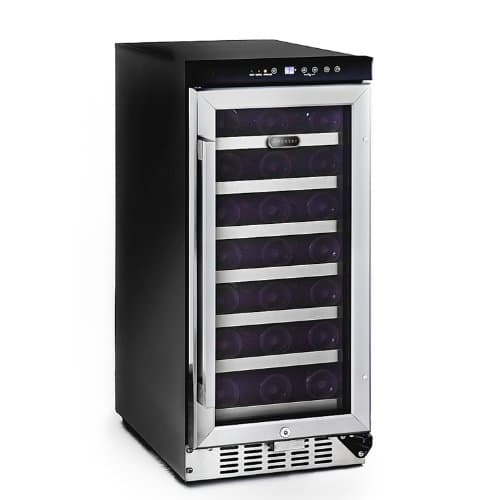
Thirty-three bottles in a 15-inch cabinet, with a published noise ceiling and seven wooden shelves — the capacity ceiling at this width, and the widest temperature band on this page.
Product photograph via Amazon.
Published specifications
Capacity
33 bottles
Zones
1
Cooling
compressor
Temperature range
40–72°F
Noise rating
42 dB
Installation
both
· Exterior: 15.0 in W x 22.5 in D (24.5 in with the handle installed) x 34.0 in H
· Capacity: 33 standard 750 ml bottles
· Noise published as "< 42 dBA" — a ceiling, not an average
Thirty-three bottles is the highest published capacity at this width
Whynter publishes a decibel ceiling, which almost nobody in this category does
Seven wooden shelves rather than the wire shelving usual at this price
40-72°F is the widest published band here, so it will also hold a bottle at room temperature
Rated for built-in or freestanding use, so an opening is optional rather than required
What does not
Single zone only — one temperature for the whole cabinet
The published figure is "< 42 dBA", a maximum rather than an average, so it cannot be compared like-for-like against a manufacturer quoting a flat number
At 15.0 inches published it is the widest cabinet in this group, which matters if your opening is tight
Depth grows to 24.5 inches once the handle is on, which is the figure that matters in a shallow run
33 bottles assumes standard Bordeaux shapes; a Burgundy-heavy collection will fit fewer
Who should skip it. Skip it if you need to serve whites cold and hold reds at cellar temperature in the same cabinet — one zone cannot do both. Skip it too if your opening measures under 15 inches, because this is the one cabinet here that needs the full module.
#ad — paid link. How this is funded. Price as of November 28, 2026; check Amazon for the current price.
#4 — Storage, not just chilling
Zephyr Presrv PRW15C01CG
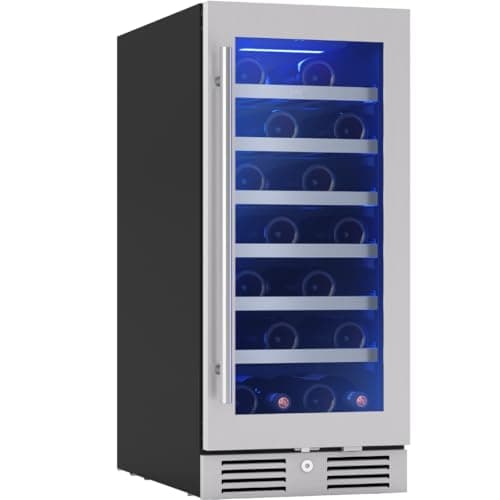
Twenty-seven bottles, a published 39 dBA, and the only cabinet in this width whose maker documents a vibration dampening system — you are paying for the storage conditions, not the bottle count.
Product photograph via Amazon.
Published specifications
Capacity
27 bottles
Zones
1
Cooling
compressor
Temperature range
38–65°F
Noise rating
39 dB
Installation
both
· Exterior: 15 in W x 33-7/8 in H x 23-3/8 in D
· Capacity: 27 bottles (750 ml), 3.4 cu ft
· Sound level: 39 dBA published
· Racking: six full-extension black wood racks with stainless trim
· Glass: dual-pane, Low-E, argon-filled
· Field-reversible door with concealed zero-clearance hinges, door lock, door-open alarm
· Energy Star certified; Sabbath mode; carbon-filtered air filtration
· Weight: 101 lb · Power: 115 V, 60 Hz at max 1.5 A
· Warranty: 2 years parts and labor, 5 years compressor
The only 15-inch cabinet here whose manufacturer documents vibration control at all
Publishes a flat decibel figure rather than a ceiling, so it can be compared properly
Reaches 38°F, the lowest published minimum in this group, which matters for sparkling wine
Full-extension racks mean you can reach a bottle at the back without unloading the shelf
Five-year compressor warranty against the usual one or two
What does not
Twenty-seven bottles against thirty-three for the same width — the racks take the space
23-3/8 inches deep, the deepest cabinet in this group
Costs materially more than the Whynter and Summit cabinets it sits beside
Who should skip it. Skip it if the wine is going to be drunk within a year or two. Vibration control and a 38°F floor are long-storage features, and you can have eight more bottles for less money without them.
#ad — paid link. How this is funded. Price as of November 28, 2026; check Amazon for the current price.
What makes a Burgundy bottle awkward
A Bordeaux bottle has high shoulders and a straight body about three inches across. A Burgundy bottle — the shape Pinot Noir and Chardonnay are usually sold in — slopes from the neck and is wider through the body; a Champagne bottle is wider still, at roughly three and a half inches. Every capacity figure published in this category is counted in Bordeaux bottles, because that is the shape that packs tightest.
The consequence is not thermal and it is not about quality. It is that shelf spacing and cradle width were designed around a narrower bottle, so a Burgundy-heavy collection either fits fewer bottles per shelf or does not sit flat at all. Two cabinet makers on this site say so in their own specifications: Newair notes that heavy Burgundy or Champagne bottles reduce its 46-bottle figure, and Whynter notes the same about the BWR-33SD’s 33. Most do not mention it.
Published shelving specification, and what it means for a wide bottle
Cabinet
Shelving
Removable
Per-shape count
Zones
Summit ALWC532PNR
6 full-extension wire shelves, stainless front trim
Capacity counts, and the one maker who is honest about it
Summit publishes the ALWC532PNR’s 46 bottles as 30 Bordeaux plus 16 wider Burgundy bottles. That single line is why it tops this page: it is the only figure on this site that actually predicts what a mixed-shape collection will do inside a cabinet, and it comes from the maker rather than from us. The cabinet is a 23.38-inch panel-ready two-zone unit, just under 32 inches high and ADA compliant, with a published 34 dB sound level and an ETL-S listing to NSF-7.
Everyone else publishes a Bordeaux-only number. That is not dishonest, it is the industry convention — but it means the figure on the box is a best case. Treat any published capacity as roughly a fifth optimistic if most of your bottles slope from the neck, which is the rule of thumb the published Summit split happens to support.
Shelving: removable, uniform, full-extension
Three shelf properties decide whether a wide bottle works, and they are independent of each other.
Removable is the first and most important. A shelf that lifts out turns an impossible bottle into a possible one; a fixed shelf does not. All five cabinets here have shelving that comes out, which is why they are here. The Koolatron WC12MG is the budget answer precisely because Koolatron specifies its wire racks as adjustable for larger or irregular bottles — at a fraction of the price of anything else on the page.
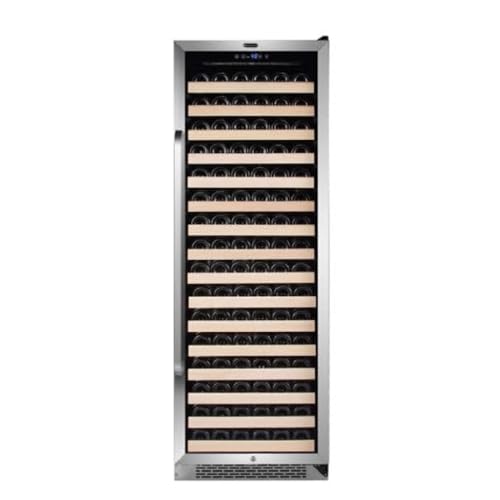
Uniform spacing is the second, and it is a consequence of zone count. A single-zone cabinet has no internal partition, so the gap between shelves is the same from top to bottom — Whynter says exactly that about the BWR-1662SD, which carries 16 removable wooden slide-out shelves plus a wire display shelf. A dual-zone cabinet has a divider, and the shelf pitch around it is usually fixed.
Full extension is the third and the most underrated. The Summit’s six shelves and the Zephyr’s six racks pull all the way out, so you can reach a bottle at the back without lifting the ones in front — which on wide bottles stored two deep is the difference between using the back row and ignoring it. The shelf types in this category are compared in wine fridge shelf types.
Why one zone usually wins here
For a Burgundy and Pinot cellar, a single zone is usually the better cabinet, and not for temperature reasons. No partition means uniform shelf spacing, more usable height for a slope-shouldered bottle and more bottles per dollar. Three of the five picks here are single-zone for exactly that reason.
Work it the other way round. If two thirds of your bottles are Burgundy-shaped and you want sixty of them in the cabinet, do not buy a cabinet rated for sixty; buy one rated for nearer eighty. On this page that means the Whynter BWR-1662SD at 166 bottles is the only pick that stores a genuinely large wide-bottle collection, the Summit at 46 is the right size for a working one, and the 33, 27 and 12-bottle cabinets are service units rather than cellars.
The same logic applies to magnums and to Champagne, which are wider again. Those have their own pages: best wine fridges for large-format bottles and best wine racks for Champagne, the second of which is often the cheaper answer: a five-bottle magnum column on the wall beside a cabinet solves the problem for a tenth of the cost of a bigger cabinet.
Which one to buy
Buy the Summit ALWC532PNR if you want the one cabinet whose maker tells you how many wide bottles actually fit. Buy the Whynter BWR-1662SD if the collection is large and one temperature is right: uniform spacing across 16 removable wooden slide-out shelves is the best wide-bottle configuration here. Buy the Whynter BWR-33SD for seven removable wooden shelves in a 15-inch gap. Buy the Zephyr if full-extension racks and documented vibration control matter more than capacity. Buy the Koolatron WC12MG if a dozen bottles is the job and you want adjustable racks for the cost of two bottles of the wine.
Questions people actually ask
▸ How many fewer bottles will a Burgundy-heavy collection fit?
Roughly a fifth fewer, judging by the only published per-shape figure in this category: Summit rates the ALWC532PNR at 46 standard bottles or 30 Bordeaux plus 16 Burgundy. Treat every Bordeaux-only capacity figure as a best case.
▸ Do I need special shelves for Pinot bottles?
No — you need shelves that come out, so you can remove one and give a wide bottle double height. Every pick here has removable shelving; a cabinet with fixed racking is the one to avoid.