
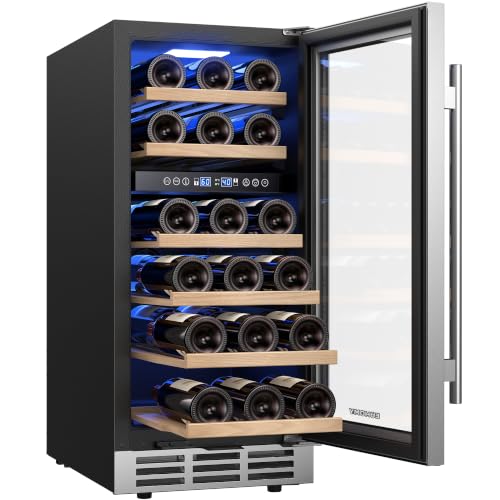
The three numbers that decide this
A dual-zone undercounter cabinet is a narrow specification, and almost every shopping mistake in it comes from checking the three defining numbers in the wrong order. Bottle count is not one of them.
One: the height. A standard American kitchen counter sits at 36 inches, and with a typical countertop and substrate the opening beneath it is about 34.5 inches. That is the gate. Every cabinet on this page publishes a height of 34.25 inches or less, and we print the figure next to each one rather than saying “fits under a counter.” Two perfectly good dual-zone cabinets in our registry are excluded on the body rather than the cooling — one of them on this number — and both are named below.
Two: the installation rating. Two zones in a cabinet that is freestanding only is not an undercounter cabinet, however it looks in the listing photograph. The rating is a statement about where the condenser dumps its heat, and the consequence of getting it wrong is a cabinet that runs warm and fails outside warranty — the full argument is in built-in against freestanding.
Three: what each zone can reach. “Dual zone” on a box tells you there are two compartments. It does not tell you whether both of them can be set to 55°F, which is the difference between a cabinet you can re-task in five years and a cabinet that is permanently half a serving fridge. Three of our five picks publish a factory-fixed split. That is not a fault — it is how most households use a cabinet — but it should be a decision rather than a surprise.
Only once those three are satisfied does capacity become interesting, and at these widths it lands between 29 and 46 bottles. If you have not fixed your number yet, what size wine fridge you need works it out from the bottles you own, and how many bottles a wine fridge really holds explains why every published count assumes Bordeaux shapes.
Two zones, and the ones the factory already split
This is the specification that separates these five cabinets more sharply than price does, and it is almost never on the front of the box.
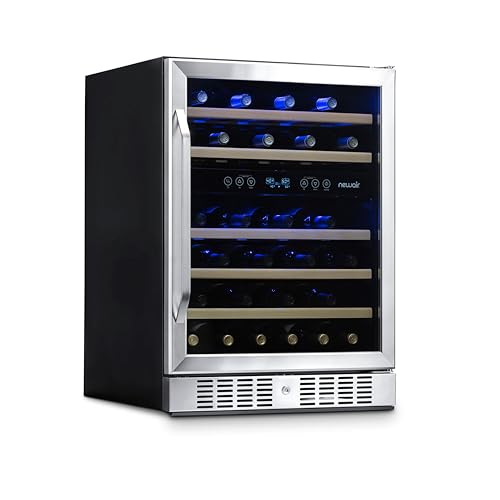
Both compartments across the full span. The Newair AWR-460DB publishes 40–66°F for each zone. The split is therefore yours to choose: service above and cellar below, two cellars at one temperature for redundancy, or reds and whites both at drinking temperature. The KoolMore KM-CW46DZ-BPR publishes 41–68°F across two zones in the same way, with the widest top end here — 68°F is above cellar temperature, which matters if one half is holding bottles you intend to open soon.
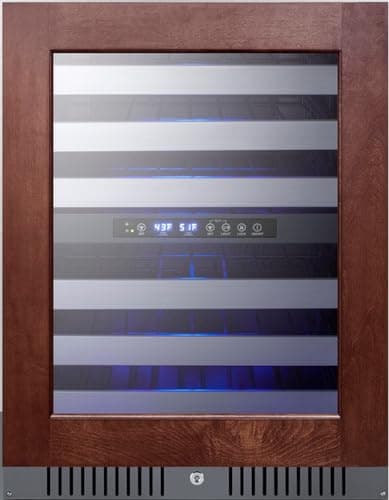
A split the factory already made. The other three publish per-zone ranges that do not overlap completely. Summit states 41–50°F upper and 50–64°F lower; Newair’s AWR-290DB states 40–55°F upper and 50–66°F lower; EUHOMY states 40–55°F upper and 55–65°F lower. On none of those three can one compartment do the whole job, so each is permanently configured as service-above, cellar-below. If that is how you will use it — and most people do — the fixed split costs you nothing. If you expect your collection to change character, it costs you the ability to re-task half the cabinet.
Two further details worth knowing before you choose. The Summit is the only cabinet here whose upper zone is published down to 41°F and capped at 50°F, which makes it the most committed sparkling-and-white service compartment in the group; and EUHOMY publishes no per-zone bottle count, so how its 33 bottles divide between the two halves is unknown until the cabinet arrives. The general case for and against a divider is in single zone against dual zone, and what to actually set each compartment to is in dual-zone temperature settings.
Height, depth and the handle nobody measures
Undercounter cabinets fail on fit more often than on performance, and the failure is almost always one of three measurements.
Height, against the opening rather than the counter. Measure from the finished floor to the underside of the countertop substrate, not to the top of the counter. Our picks publish 32.00 inches (Summit), 33.00 (Newair 460DB), 33.75 (Newair 290DB), 34.00 (KoolMore) and 34.25 (EUHOMY). In a standard 34.5-inch opening the Summit leaves two and a half inches of daylight and the EUHOMY leaves a quarter of an inch — which is not enough to level a cabinet on an uneven floor. If your floor is tile over an older subfloor, treat the EUHOMY as a 15-inch freestanding cabinet that happens to be front-vented, and plan accordingly.
Depth, with the handle or the panel fitted. The number on the listing is usually the cabinet body. Newair publishes 22.40 inches for the AWR-460DB and 24.00 with the handle; the AWR-290DB is 22.60 and 24.25 with its handle. Summit publishes 23.5 inches and 24.25 with the panel in place, plus a figure almost nobody prints — 47.38 inches of depth with the door open at 90 degrees, which is the measurement that decides whether the door clears a kitchen island behind you. KoolMore publishes 22.6 inches excluding handles, and does not include a handle in the box at all.
Width, against a cabinetry module rather than a tape measure. Kitchen runs come in modules: a 15-inch gap or a 24-inch gap, with very little in between. Three of these cabinets are 23.38 to 23.4 inches wide and two are 14.8 to 14.9. Pick the module first and the cabinet second — 24-inch wine coolers and 15-inch wine coolers rank each width on its own terms, and the dimensions guide lists the measurements to take before you order anything.
One last fit question that is really a plumbing-and-cabinetry question: which way the door opens. The EUHOMY and the KoolMore publish a reversible door, Summit sells the ALWC532PNR with a right-hand swing as standard and a separate left-hand model for the other case, and the two Newairs are what they are. In a corner or beside a run of drawers that is the difference between a usable cabinet and a daily annoyance — reversible doors and door swing covers how to plan it and how the reversal is actually done.
Why the built-in rating is the whole purchase
Everything on this page is front-breathing: the condenser draws air through the plinth or the grille at the bottom of the door and exhausts it forward, rather than relying on a gap behind and above the cabinet. That is the single specification that makes an undercounter installation legitimate.
It is worth being precise about what the makers claim. Summit publishes front-breathing operation with both interior and exterior fans and an automatic defrost, and rates the cabinet for built-in use. KoolMore publishes a front plinth vent and a minimum clearance of 0.25 inches at the sides and back — a real number, which is rarer than it should be. Newair rates both cabinets for built-in or freestanding use, and EUHOMY does the same. None of that removes the need to leave the plinth clear: a built-in rating assumes the front is open to the room, and a decorative kickplate that seals the vent will cook the cabinet as surely as a tight back.
The practical consequences, in order: leave the vent unobstructed, give the cabinet the clearance its maker publishes, and do not enclose a cabinet rated freestanding-only no matter how good the deal is. Ventilation and clearance sets out what each class needs, how to install a wine fridge under a counter gives the sequence of work, and can you put a freestanding wine fridge under a counter answers the question people ask after they have already bought the wrong one.
A dual-zone cabinet makes the electrical question slightly more pointed than a single-zone one, because it is working two compartments against each other. Nothing here draws much — Summit publishes 1.25 A at 115 V, KoolMore 100 W and 180 kWh a year — but it should be on a circuit that is not also feeding a microwave and a toaster. Does a wine fridge need a dedicated circuit works through what the published figures mean for a kitchen.
What each maker is willing to publish
Our ranking rewards documentation, because in this category it is the only thing that can be checked before the cabinet is in your kitchen.
Noise. Three of these five publish a figure: Summit 34 dB, EUHOMY “under 38 dB” and KoolMore 45 dB. Read them carefully. Summit’s is a flat number, EUHOMY’s is a ceiling rather than an average, and KoolMore’s 45 dB is the highest figure here by a clear margin — which is honest of KoolMore and worth respecting if the cabinet is going into an open-plan kitchen you sit in. The two Newairs publish nothing at all, so we do not score them on noise in either direction. The reasoning is in the noise guide, and the cabinets that publish the lowest numbers across the whole registry are ranked in best quiet wine fridges.
Shelving. Newair ships removable beechwood in the 460DB, EUHOMY six removable wooden shelves specified to reduce vibration, and KoolMore five black beech shelves with a published 3.6 inches between them — which is the figure that tells you whether a Champagne bottle will go in. Summit is the outlier: six full-extension wire shelves with stainless trim. Full extension is genuinely useful at the back of a deep cabinet, but it is wire, and the case for wood is made in best wine fridges with wooden shelves. For large-format bottles the question is not the material but whether a shelf comes out at all — the large-format roundup ranks the registry on exactly that.
Security, alarms and warranty. Summit and EUHOMY both ship a factory-installed lock with two keys. KoolMore publishes door-ajar and high-temperature alarms — the only cabinet here that will tell you something is wrong — and the longest cover in the group at three years parts and labor plus five on the compressor, against Summit’s one plus five. If the lock is the point rather than a bonus, best lockable wine fridges ranks the registry on it.
And one caveat on the panel-ready pair. Both the Summit ALWC532PNR and the KoolMore KM-CW46DZ-BPR ship without a door front: Summit publishes a recommended panel of 3/4-inch material at 29 1/4 by 23 1/8 inches, and KoolMore ships no handle. That is a cabinetmaker’s job and a line in the budget, not an inconvenience to discover on delivery day. Best panel-ready wine fridges ranks the registry on whether the maker publishes the dimensions a joiner actually needs.
What did not make the page, and why
Four cabinets in our registry publish two zones and are excluded here, and the reasons are worth stating because each one is a trap on a page like this.
- Whynter BWB-3388FDS and Summit SWBV3067B — too wide, and in one case too tall. Both are excellent two-zone cabinets. The Whynter is 29.75 inches wide and the Summit 29.5, so neither drops into a 24-inch module, and the Summit publishes 34.38 inches of height, which is taller than a standard opening. Both are wine-and-beverage combination cabinets and both are ranked in best wine and beverage refrigerators.
- Whynter BWR-1642DZ — the wrong shape entirely. A 24-inch dual-zone cabinet at 164 bottles is a full-height column, not an undercounter unit. It is the right answer to a different question, argued in wine column against undercounter wine fridge.
- Dacor DRW24G7500, KingsBottle 24 Dual and Kalamera KRC-46DZB — no live listing. All three are genuine dual-zone undercounter cabinets, and we rank them elsewhere on specification. None of them had a live Amazon price on this read, so a card here would be a link to a search page rather than a purchase. The dealer-channel versions of this class are in best luxury wine fridges.
If the fixed splits above are the problem rather than the fit, the honest alternative is one temperature and more bottles: best single-zone wine fridges makes that case, and at 15 inches a single-zone cabinet buys you both shelves and span.
Which one to buy
Buy the Newair AWR-460DB for a 24-inch opening. Forty-six bottles, two zones that each cover a published 40–66°F, 33.00 inches tall and 24.00 deep with the handle, 5.3 cubic feet, removable beechwood shelving, double-tempered UV glass and a built-in rating. It is the only cabinet here that gives you a free choice of what each half does, and it is the cheapest of the three 24-inch picks. The honest costs: no published decibel figure, no lock, and 46 bottles is Newair’s count using standard Bordeaux bottles.
Buy the Summit ALWC532PNR if you want the best-documented cabinet. It publishes more than anything else on this page: 34 dB, 46 bottles broken out as 30 Bordeaux and 16 Burgundy, 32.00 inches of height, 47.38 inches of door-open depth, a panel specification to the eighth of an inch, ADA compliance just under 32 inches, an ETL-Sanitation listing to NSF-7 for commercial rooms, a lock with two keys and front-breathing operation with interior and exterior fans. The costs are real: the zones are fixed at 41–50°F and 50–64°F, the shelves are wire rather than wood, and you are buying a cabinet that needs a joiner to finish it.
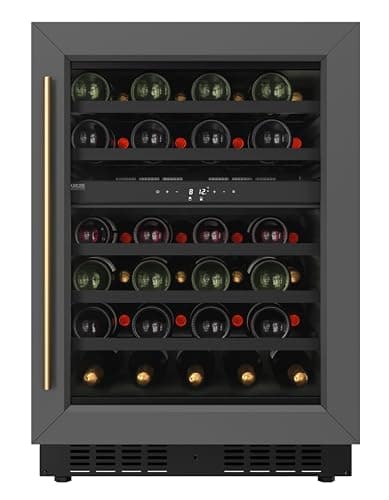
Buy the KoolMore KM-CW46DZ-BPR for the widest usable span and the alarms. Forty-five bottles, two zones across 41–68°F, five beech shelves with a published 3.6-inch gap, a published ambient operating range of 60–90°F, a reversible self-closing door, door-ajar and high-temperature alarms and three years of parts and labor. Against that: 45 dB published, which is the loudest here; a digital control panel mounted inside the cabinet, so you open the door to change anything; no handle in the box; and 34.00 inches of height, which needs a true 34.5-inch opening.
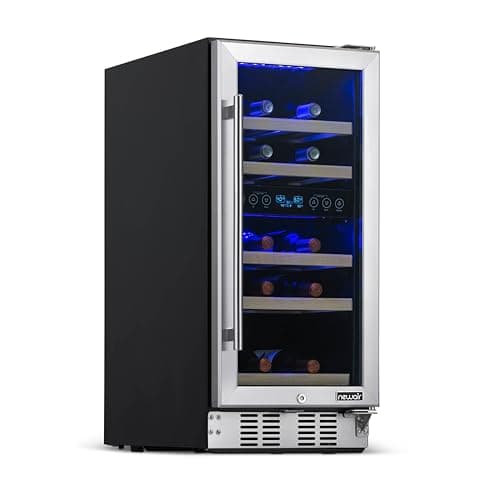
Buy the Newair AWR-290DB for a 15-inch gap on a service split. Twenty-nine bottles, upper zone 40–55°F and lower 50–66°F, 33.75 inches tall, 24.25 deep with the handle, 70 lb, triple-tempered UV glass and a built-in rating. It is the right cabinet for a household that chills whites and holds reds and will never want it arranged any other way. Twenty-nine bottles fills fast if you buy by the case.
Buy the EUHOMY BC-90CU-E as the cheapest way into two zones. Thirty-three bottles at 14.9 inches wide, a published noise ceiling under 38 dB, six removable wooden shelves, a reversible door and a lock with two keys, front-vented and rated both ways. It is comfortably the least expensive cabinet on this page. The caveats matter more here than anywhere else: 34.25 inches of published height leaves a quarter-inch in a standard opening, the split is fixed with the cold half always on top, EUHOMY publishes no per-zone bottle count and no wattage or weight, and at 23 inches it is deeper than the Newair at the same width.
Whichever you choose, do two things on day one. Set it up rather than plugging it in and filling it — how to set up a new wine fridge — and put a logging thermometer on a middle shelf in each zone, because a dual-zone display reports what two control boards are aiming at rather than what the bottles are in. Best wine fridge thermometers and hygrometers ranks those on published accuracy, and they cost a rounding error against the cabinet. If the budget is the binding constraint rather than the opening, best wine fridges under $500 is where the cheapest pick here leads, and best wine fridges under $1,000 covers the bracket most of this page sits in.