What the second thousand buys
Going from a thousand-dollar ceiling to a two-thousand-dollar one does not buy you a better version of the same cabinet. It buys four things that simply do not exist in the bracket below, and which of them you want decides this entire page.
- Capacity past 150 bottles. Under $1,000 the biggest cabinet on this site holds 46. Here, one holds 166 — and it is not the most expensive pick on the page.
- A panel-ready door. A door frame built to accept a cabinetmaker’s panel, so the appliance disappears into the run. Nothing under $1,000 offers it.
- Documented performance figures. A flat decibel measurement rather than a ceiling, an Energy Star listing, a published annual kWh figure, a five-year compressor warranty.
- Bodies that fit awkward openings. A cabinet under 18 inches deep, or one at ADA counter height with legs that raise it to a standard 34 inches.
If none of those four describes your situation, the honest advice is to spend less: best wine fridges under $1,000 covers the same job for a 15 or 24-inch opening at up to 46 bottles, and the money saved buys a lot of wine. This page is for the buyer whose kitchen or collection has outgrown that.
Five cabinets, five different openings
The useful way to read this bracket is as five answers to five different cabinetry problems, not as a ranked list of quality. Three of the five are 24-inch class, one is a 15-inch module and one is a 30-inch cabinet that will not fit either.
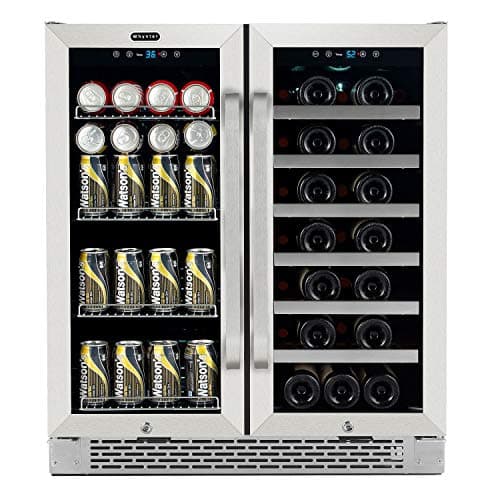
Two of those rows deserve a warning rather than a bullet point. The Whynter BWB-3388FDS is a 30-inch cabinet: it is excellent at what it does, and it will not drop into the 24-inch gap most kitchens have. And Summit publishes no temperature range for the ASDW2412 in the listing our specification came from, which on a wine cabinet is a genuine omission — we are not going to fill it in with a plausible-looking number.
Measure before you shortlist, not after. The dimensions guide sets out width, depth and height in the order they actually fail, and ventilation and clearance covers the air each installation type needs — the KoolMore is the only cabinet here that publishes a clearance figure at all, at a quarter inch to the sides and back.
The 166-bottle outlier
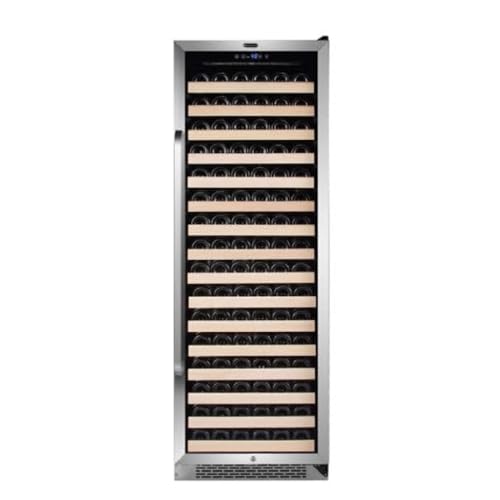
One pick on this page changes the arithmetic of the whole category. The Whynter BWR-1662SD publishes 166 bottles in a 24-inch built-in cabinet with 16 removable wooden slide-out shelves plus a wire display shelf, on a published 140 W draw — and it is priced in the middle of this bracket, not at the top.
Per bottle, nothing else on this site is close. A 46-bottle cabinet in the bracket below costs roughly a third of this one and holds roughly a quarter of the wine; do the division on the live prices shown on the cards and the big cabinet wins decisively. That is the uncomfortable truth about buying storage in stages: the cheapest way to store a lot of wine is one big cabinet bought once, and the second-cheapest is an unpowered rack in a cool room.
Three honest caveats before you treat that as a recommendation. It is a single zone, which is the correct configuration for a cellar and the wrong one for a bar — the full argument is in single zone against dual zone, and the dual-zone sibling of this exact cabinet is compared head to head in Whynter BWR-1642DZ against BWR-1662SD. It publishes no decibel figure. And 166 bottles is a manufacturer count with standard Bordeaux glass: a Burgundy or Champagne-heavy collection fits materially fewer, for the reasons in how many bottles a wine fridge really holds. A full load is also over 300 pounds of glass and liquid, so the floor and the cabinetry are part of the purchase.
Panel-ready, and what it really costs
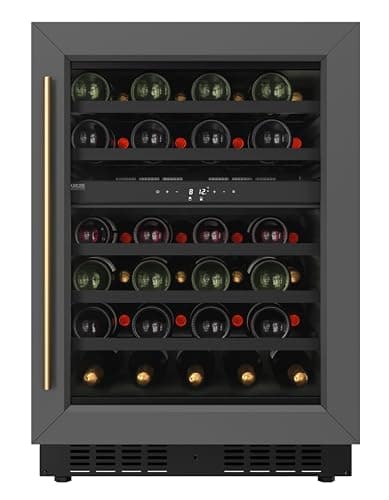
A panel-ready cabinet is sold without a finished door front: the frame accepts a panel your cabinetmaker builds, so the appliance reads as joinery rather than as an appliance. This is the cheapest bracket in which it exists, and the KoolMore Reserve KM-CW46DZ-BPR is the pick here — 45 bottles, two zones each covering a published 41–68°F, five black beech shelves, front plinth ventilation, a self-closing articulated hinge designed for the weight of a custom panel, and a three-year parts-and-labor warranty against the one year that is standard in this category.
Two costs are not on the price tag. The first is the panel itself, which is a separate purchase from a different trade: budget for it before you commit. The second is specific to this cabinet and we will say it plainly even though it is our panel-ready pick — KoolMore does not publish the panel size or thickness the frame accepts, so your cabinetmaker has to measure the unit in person. Summit publishes exact panel dimensions on its panel-ready cabinets and KoolMore does not, and that difference gets paid for in joinery hours. If your cabinetmaker quotes from drawings, best panel-ready wine fridges ranks this whole class on exactly that disclosure, and the Summit cabinets there are the ones to shortlist instead.
The KoolMore also publishes 45 dB, the loudest figure on this page, ships without a handle and lists no lock. And its digital control sits inside the cabinet, so changing the temperature means opening the door. None of that is disqualifying behind a custom panel in a kitchen; all of it is worth knowing first.
Noise and warranty: the specs that get better here
This is the bracket where manufacturers start publishing figures they can be held to, and the Zephyr Presrv PRW15C01CG is the clearest example on the page.
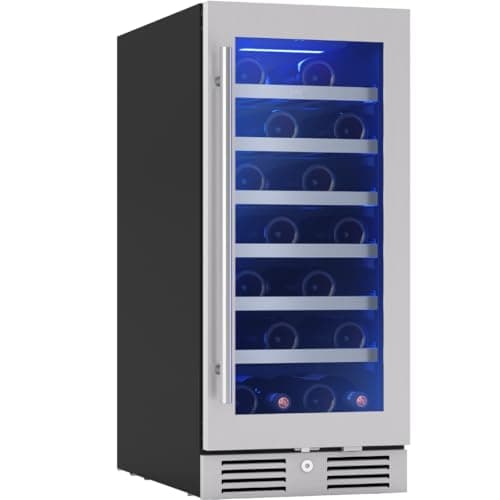
It publishes 39 dBA as a flat measurement rather than as a ceiling, which means it can be compared properly against another flat figure — the distinction our noise guide keeps making, and the reason best quiet wine fridges ranks on published numbers and not adjectives. It publishes a 38°F floor, the lowest minimum in this group, which is what sparkling wine service actually wants. It is Energy Star certified with Sabbath mode and carbon-filtered air filtration. It has six full-extension racks, so the bottle at the back comes out without unloading the shelf. And it carries five years of compressor coverage against the usual one or two.
The price of all that is capacity: 27 bottles at a 15-inch width, where the Whynter single-zone cabinet in the bracket below publishes 33 at the same width. It is also the deepest cabinet in this group at 23-3/8 inches. If the wine will be drunk inside a year or two, those long-storage features are not worth eight bottles of capacity to you — if it will not, they are the whole point, which is the case made in best wine fridges for long-term storage and the vibration and light roundup.
What is still missing under $2,000
Three things, and they are the reason the bracket above this one exists.
A full-height column. Nothing here is a 30-inch-tall-and-up integrated column; these are all undercounter or freestanding bodies. Wine column against undercounter sets out what a column buys and what it costs.
Documented humidity control. Carbon filtration is about air, not moisture, and none of these cabinets publishes an active humidity specification. What a cabinet can and cannot do is in do wine fridges control humidity.
The specialist cellaring brands. EuroCave, Liebherr and the integrated Dacor and JennAir cabinets sit above this ceiling and, more importantly for a buyer, are sold through appliance dealers rather than Amazon — which is why every pick on best luxury wine fridges links to a search rather than to a listing. If your ceiling is $2,000 and you want to click Buy, this page is the realistic end of the market.
Which one to buy
Buy the Whynter BWR-1662SD if you are storing wine. One hundred and sixty-six bottles, 16 slide-out wooden shelves plus a display shelf, uniform spacing that takes a tall bottle anywhere, 140 W, in a 24-inch built-in body. It is the best value on this page by a distance and the right answer for a cellar rather than a bar. One zone, no published decibel figure, and a full load is a serious floor load.
Buy the KoolMore KM-CW46DZ-BPR if the door has to disappear. Forty-five bottles, two zones each across 41–68°F, beech shelving where the panel-ready competition uses steel or wire, a quarter-inch published clearance that genuinely suits tight joinery, and three years of parts-and-labor cover. Accept that your cabinetmaker will have to measure the frame themselves, and that 45 dB is the loudest figure here.
Buy the Zephyr Presrv PRW15C01CG if the wine is staying for years. A flat 39 dBA, a 38°F floor, Energy Star, full-extension racks, zero-clearance concealed hinges and a five-year compressor warranty, in a 15-inch module. The cost is 27 bottles and the deepest body in the group.
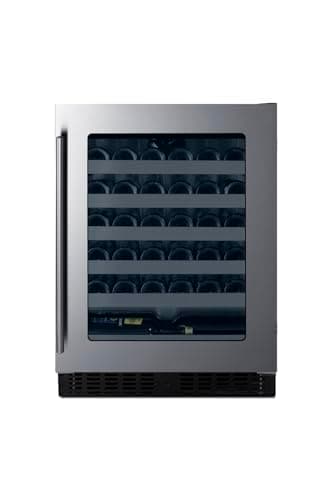
Buy the Summit ASDW2412 if your run is shallow or your counter is low. Under 18 inches deep solves the single most common undercounter fit failure, and the 32-inch ADA height adjusts up to 34 with the legs and kickplate. Thirty-three bottles is the price of the shallow depth, and Summit does not publish a temperature range for it, which you should weigh honestly.
Buy the Whynter BWB-3388FDS if the cabinet has two jobs. The cheapest pick on this page, and an unusual one: 33 bottles on the wine side and a published 113 cans on the other, both zones adjustable across 36–72°F, six wood shelves on the wine side, a sub-38 dB ceiling. It needs 30 inches of width, the French doors are not reversible, and Whynter’s own per-shelf can breakdown does not add up to 113, so treat that figure as nominal. The class is covered properly in best wine and beverage refrigerators.
Whatever lands in the opening, the install is the part that goes wrong: confirm the built-in rating, the clearance and the electrical supply before delivery day. How to install a wine fridge under a counter is the sequence, and whether you need a dedicated circuit is the question most people ask an electrician too late.
This bracket includes a full-height column and a 15-inch cabinet that are not counter-height purchases. If the cabinet has to fit under a worktop, the filtered version is best undercounter wine fridges under $2,000.