
What five hundred dollars actually buys
Five hundred dollars is a more interesting ceiling than it was a year ago, because it has stopped being a thermoelectric-only bracket. Three things are now available inside it, and none of them is available at three hundred.
A compressor. Three of our five picks are compressor-cooled, which means the cabinet holds its setting whether the room is 65°F or 85°F. Thermoelectric cooling works against ambient temperature, so its achievable minimum rises with the room — the mechanism, and the honest case for each, is in compressor against thermoelectric.
A built-in rating. Two cabinets here publish front-venting and a rating for built-in or freestanding use. That is unusual at this price and it is the most expensive specification to get wrong, because enclosing a freestanding cabinet makes it recirculate its own waste heat.
Wooden shelves that come out. Seven of them on our top pick, six on the runner-up. At the bottom of the market shelving is fixed chrome wire, and a shelf that does not come out is the reason a Champagne bottle will not go in.
What five hundred dollars does not buy is capacity above about 33 bottles, a panel-ready door, documented vibration control or a 24-inch cabinet of any kind. Those start in the next bracket, which is best wine fridges under $1,000.
The line this bracket sits on
There is a real line running through this page, and it is not price. It is the floor temperature each cabinet can reach and whether the room gets a vote.
Above the line: 40–41°F floors, independent of the room. The Whynter BWR-33SD publishes 40–72°F, the EUHOMY 40°F in its upper zone and the Ivation 41–64°F. A 40°F floor is cold enough for sparkling service, and a 72°F ceiling on the Whynter is wide enough to hold a bottle at room temperature on purpose. None of those figures moves when the kitchen gets warm.
Below the line: 46°F floors, and the room gets a vote. Both thermoelectric cabinets here publish a 46°F minimum — the Whynter WC-201TD at 46–66°F and the Schmécké at 46–64°F. That is perfectly good cellar and white-wine territory and it is not cold enough for Champagne service. Worse, it is a figure measured in a reasonable room: thermoelectric modules lose the argument above roughly 77°F ambient, which rules them out of a garage, a conservatory or an un-airconditioned apartment in August. Our garage-specific picks are in best garage-ready wine fridges.
The compensation is genuine, though, and it is the reason two thermoelectric cabinets are still on this page. There is no compressor, so there is no cycling, no start-up thump and no vibration path into the bottles — Whynter describes the WC-201TD’s cooling as vibration-free, and at 65 W it draws a fraction of what a compressor cabinet does. In a bedroom, a studio apartment or a shared-wall condo that trade is often the right one, and the full version of it is in best thermoelectric wine coolers and best wine fridges for apartments.
The two you can build in, and the three you cannot
This is the specification most shoppers in this bracket never check, and it decides whether the cabinet has a future in a kitchen or only on a floor.
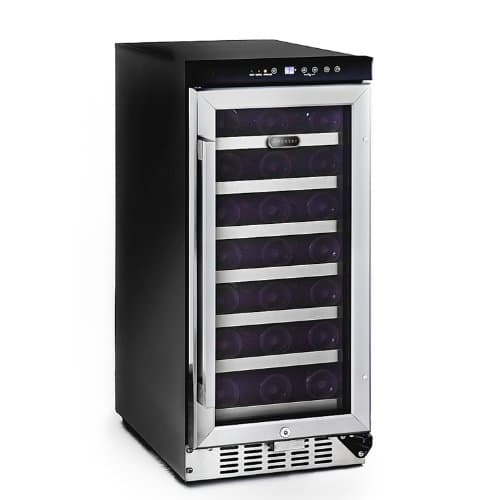
The Whynter BWR-33SD and the EUHOMY BC-90CU-E are both published as built-in or freestanding: the condenser breathes through the front, so either cabinet can be dropped into a 15-inch cabinetry module. The Ivation, the WC-201TD and the Schmécké are freestanding only, and the thermoelectric pair reject heat from a sink at the back, which is precisely why no mainstream thermoelectric cabinet carries a built-in rating at all — the catalog check behind that claim is in built-in thermoelectric wine coolers.
The consequence is worth spelling out, because it is the most common and most expensive mistake in this bracket. A freestanding cabinet pushed into a tight opening recirculates its own waste heat, runs warm, works harder and usually fails outside warranty. If you already own one and the opening is already built, can you put a freestanding wine fridge under a counter sets out the ways out, and ventilation and clearance gives the air gaps each class needs. If an enclosed installation is the whole point, 15-inch wine coolers ranks that module on fit.
Two zones under $500, and what the divider costs
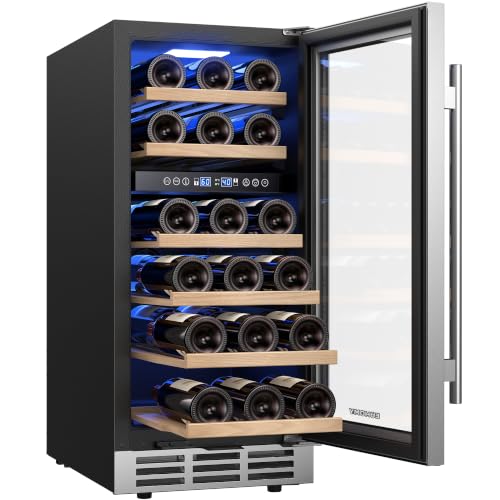
Exactly one cabinet on this page publishes two independently controlled compartments: the EUHOMY BC-90CU-E, at 40–55°F above and 55–65°F below. If you want to serve whites cold and hold reds at cellar temperature in one cabinet under $500, it is the only option here.
Two things to understand before you choose it. First, the split is fixed: neither compartment covers the whole span, so the cold half is always the top one and the cabinet cannot be re-tasked later. Second, EUHOMY publishes no per-zone bottle count, so how the 33 bottles divide is unknown until the cabinet arrives. Against that it publishes a noise ceiling under 38 dB, a reversible door and a lock with two keys, which is a lot of specification for the money.
The honest comparison is with the single-zone Whynter at the same width and a slightly higher price: the same 33 bottles, seven removable wooden shelves rather than six, and a wider 40–72°F band — but one temperature for everything. If every bottle in your house sits at the same temperature, one zone is more cabinet for the money, and the argument in full is in single zone against dual zone. If two zones and an enclosed installation are both requirements, the cabinets that publish both are ranked in best dual-zone undercounter wine fridges, and most of them cost more than this page’s ceiling.
Bottles per dollar, honestly
We do not type prices into our pages — a stale number is worse than no number — but the arithmetic on the live figures above points one way, and it is worth doing before you buy the cheapest thing on the list.
The two 33-bottle cabinets are the value in this bracket, and they are not the cheapest cabinets in it. They hold between one and a half and nearly three times what the 12-, 18- and 20-bottle units hold, for well under three times the money. On cost per bottle, the top two picks win this page outright.
The cheapest cabinet here is the most expensive per bottle. That is the standing shape of this category: small cabinets carry the same compressor or module, the same door and the same control board across fewer bottles. Buying a 12-bottle cabinet because it is the cheapest is how people end up buying a second cabinet a year later.
And per-bottle cost keeps falling above this bracket. A 46-bottle 24-inch cabinet in the next bracket up costs less per bottle than anything here, which is the uncomfortable truth about buying small. Work out the number you will actually keep first — what size wine fridge you need does it from the bottles you own, and how many bottles a wine fridge really holds explains why every published count is optimistic.
What $500 does not buy
Five things are missing from every cabinet on this page. Knowing that up front is worth more than another paragraph of praise.
- No 24-inch cabinet, and no capacity above 33 bottles. The widest cabinet here is 15 inches. If your opening is a standard 24-inch module, this bracket has nothing for it — 24-inch wine coolers starts higher.
- No documented vibration control, except by absence. The thermoelectric cabinets have no compressor, which is a real structural answer. No maker here publishes a vibration measure for a compressor cabinet, so we do not claim one; the cabinets whose makers do are in the vibration and light roundup.
- No humidity control. Two cabinets here ship an activated carbon filter, which is about air rather than moisture. What a cabinet can and cannot do about humidity is in do wine fridges control humidity.
- No published decibel figure on three of the five. Whynter publishes “under 42 dBA” for the BWR-33SD and EUHOMY “under 38 dB”; the Ivation, the WC-201TD and the Schmécké publish nothing, and we will not invent a number for them.
- No long-term cellaring claim. None of these cabinets is built to hold wine for a decade, and we would not ask one to. The registry’s long-haul cabinets are in best wine fridges for long-term storage, and they cost multiples of this page.
When to spend less, and when to spend more
Spend less if the cabinet is for a dozen bottles you will drink this year and it is standing on a counter. The bottom of the market is honestly ranked in best cheap wine fridges, which is a thermoelectric page by design — the Koolatron WC10 and the mirrored-door WC12MG both sit under this ceiling too, and both lost their place here to cabinets that hold more bottles or reach a lower temperature. For the smallest class generally, best small wine fridges covers 10 to 29 bottles.
Spend more if you need a 24-inch module, more than 33 bottles, or two zones that each cover the full span. Best wine fridges under $1,000 is the bracket where a 46-bottle dual-zone cabinet appears, and three of this page’s picks are on that page too — the extra five hundred dollars buys width, capacity and a free choice of zone temperatures, not a better version of the same cabinet. For context on what drives price in this category at all, see how much a wine fridge costs.
Spend nothing on a cabinet if you have a cool, dark, stable room. An unpowered rack in the right place beats a cheap cabinet in the wrong one, which is the case made in wine rack against wine fridge and at the budget end in best wine racks under $50, where fifty dollars buys 36 bottles of storage.
Which one to buy
Buy the Whynter BWR-33SD as the best cabinet under $500. Thirty-three bottles in a 15-inch body — the highest published capacity at that width — compressor-cooled across 40–72°F, a published ceiling under 42 dBA, seven removable wooden shelves with stainless fronts, a security lock, an activated carbon filter and a built-in rating. At 80 W it is also frugal for a compressor cabinet. The honest costs: one zone only, 15.0 inches means it needs the full module, depth grows to 24.5 inches once the handle is fitted, and 33 bottles assumes Bordeaux shapes.
Buy the EUHOMY BC-90CU-E if you want two zones for the least money. The only dual-zone cabinet under this ceiling: 33 bottles at 14.9 inches wide, a published noise ceiling under 38 dB, six removable wooden shelves, a reversible door, a lock with two keys and a built-in-or-freestanding rating. The caveats are the fixed 40–55°F upper and 55–65°F lower split, the absent per-zone bottle count, a published height of 34.25 inches that leaves almost nothing in a standard counter opening, and 23 inches of depth.
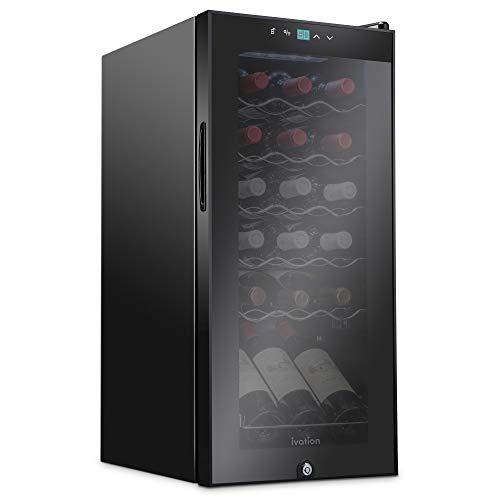
Buy the Ivation 18-bottle compressor as the cheapest cabinet that ignores the room. A compressor, a 41°F floor cold enough for sparkling service and a lock, for a fraction of the ceiling. It is freestanding only, single-zone, publishes no decibel figure, and at this size the compressor is close to you — which is the one thing to weigh before it goes in a bedroom or a home office.
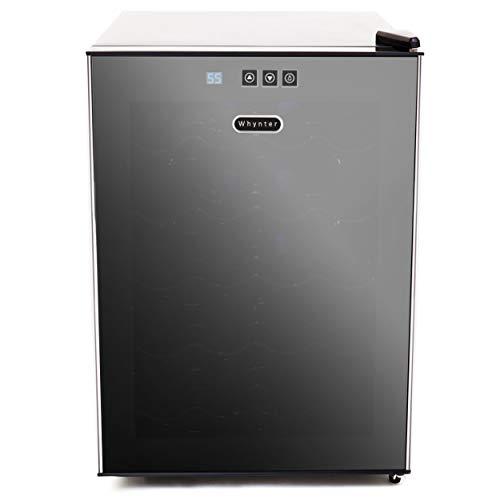
Buy the Whynter WC-201TD if silence matters more than a cold floor. Twenty bottles, thermoelectric so nothing cycles and nothing transmits vibration into the wine, 65 W, five removable stainless-trimmed shelves and a mirrored glass door. Its 46°F floor is not sparkling-service cold, it must not be enclosed, and it will struggle in a room above roughly 77°F — but in a quiet room it is the most pleasant cabinet here to live with.
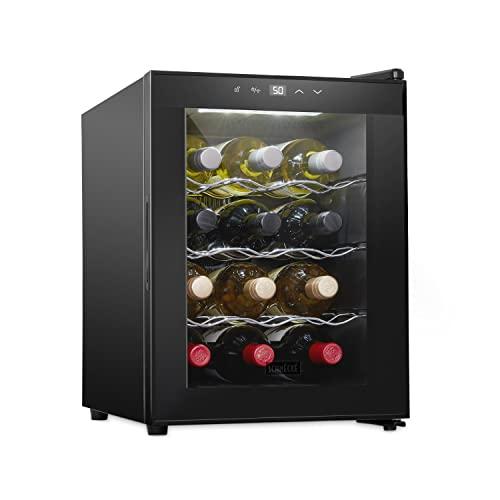
Buy the Schmécké 12-bottle as the budget pick. The cheapest cabinet on this page: a dozen bottles at 46–64°F behind smoked glass, with a digital readout and no compressor. It is the right size for a household that drinks rather than collects. It is also the most expensive cabinet here per bottle, its cooling depends on the room, and it should not sit on a counter that gets afternoon sun.
Whichever you buy, two things are worth doing on day one: set it up properly rather than plugging it in and filling it — how to set up a new wine fridge — and put a thermometer on the middle shelf, because at this price the display reports what the control board is aiming at rather than what the bottles are in. Best wine fridge thermometers and hygrometers ranks those on published accuracy, and the cheapest of them costs about a twentieth of the cheapest cabinet here.
One bracket down, the choice narrows to five cabinets and the compressor argument gets sharper: best wine fridges under $300.